|
-
5th December 25, 02:31 AM
#31
 Originally Posted by jlove

Hello everyone,
I can't find a definite answer on the internet so I thought I would ask here. Next month, I'm attending a Burns supper. Would it be looked down upon if I wear a fly plaid with my PC? Possibly thinking primary using it just for photos and remove it once I sit down and have dinner. I will be attending as a guest and not a part of the event.
Many Thanks!
Highland dress is subject to the same rules of style and taste as any, and, as Hardy Amies correctly advised us, a man should look as if he has '...bought his clothes with intellegence, put them on with care, and then forgotten all about them.'
For intellegence, we can read taste, understanding and discretion.
Whilst no longer considered and essential part of Highland dress, the plaid is like no other garment - and if chosen with intellegence and put on with care, it can lift a kilt outfit to an agreeably higher degree with its romentic dash and elegance. But it is a difficult thing to forget all about.
The fly-plaid is often scorned, and has been described in print as a scrappy bit of rag - quite unfairly, in my view. However, the more material in a plaid, the better it looks, and most fly-plaids that I have seen appear too skimpy and so open to scorn.
For a smart evening dinner such as a Burns' Night, a plaid is perfectly proper and they are often seen with a Prince Charlie doublet. But it should be remembered that a plaid is an over-garment worn instead of a top-coat, so one with enough material to do its job is better, both practically and in appearace, than the small, square fly-plaid.
What you might call a 'full-plaid' of about three and a half yards length can be worn in a number of ways, and is taken off easily when sitting at table or when dancing.
You mention wearing a fly-plaid essentially for its posing-for-photos effect, which no-one could really object to, but if the look of a plaid is wanted, the full-plaid is by far much better. The wrapped across the body piper-style is awkward with an open doublet like a Prince Charlie, so having it folded in what people now call 'laird style' and carried casually over the left shoulder is more authentic, and can be arrange to show a cascade of tartan if that is your aim.
Removing the plaid and draping it over the back of your chair is both the careful and intellegent thing to do after the photos have been taken and the soup is being served, and you can then forget all about it until the end of the evening. This is when you find yourself running through the rain to find your car, and the benefit of a full-plaid is obvious - both to you and your lady who gets wrapped-up cosily at your side.
-
-
5th December 25, 07:23 AM
#32
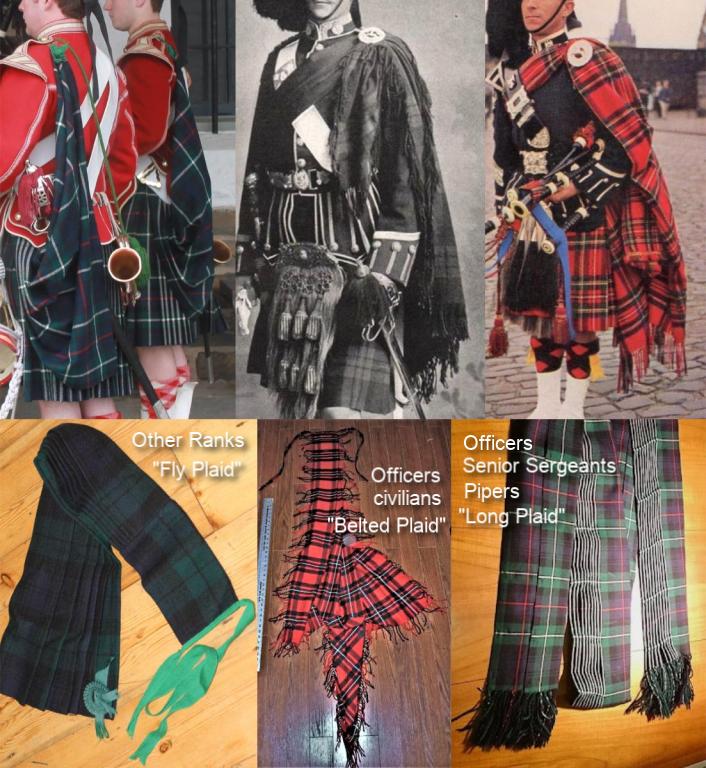
Here's the thing I put together a while back to try to explain the somewhat confusing plaid situation.
Proud Mountaineer from the Highlands of West Virginia; son of the Revolution and Civil War; first Europeans on the Guyandotte
-
-
5th December 25, 08:27 AM
#33
Originally Posted by OC Richard
Here's the thing I put together a while back to try to explain the somewhat confusing plaid situation.
It might be useful to add a Drummer's Plaid to this montage to show the comparison.
-
-
6th December 25, 09:57 PM
#34
Originally Posted by figheadair
It might be useful to add a Drummer's Plaid to this montage to show the comparison.
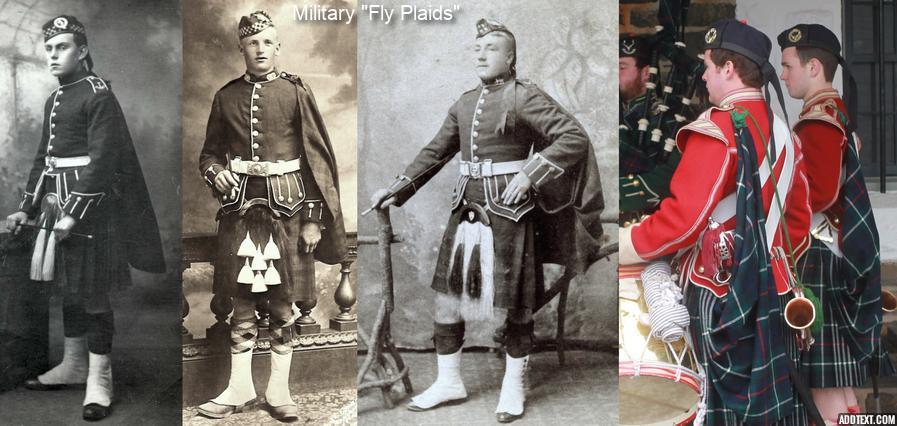
That's the thing, the "drummer's plaid" is the Other Ranks plaid worn after c1800, called the "fly plaid" in some of the regulations.
When Full Dress was abolished in 1914, afterwards generally only worn by bandsmen and the Pipes & Drums, it was the drummers of the Pipes & Drums who wore them due to them being Other Ranks.
Bandsmen, that is, members of the military band (UK terminology) wore long plaids (so-called "pipers plaids") leaving the only people in the regiment, after 1914, wearing the plaids once worn by all Other Ranks the drummers of the Pipes & Drums. (When civilian pipe bands adopted military-style kit they had "pipers plaids" and "drummers plaids" not realising that both titles were misnomers, though they should have done seeing that Drum Majors generally wore Long Plaids.)
AFAIK the military "fly plaids" were the only sort of plaid not also worn in civilian Highland Dress.
The features that set them apart from "belted plaids" (worn in civilian Evening Dress, and by officers and others in the army) were less yardage, no fringe, and using ribbons (or a loop of cord) to attach to the left epaulette. ("Belted plaids" had purled fringe all around and were pinned with a brooch.)
Last edited by OC Richard; 6th December 25 at 10:24 PM.
Proud Mountaineer from the Highlands of West Virginia; son of the Revolution and Civil War; first Europeans on the Guyandotte
-
-
6th December 25, 10:31 PM
#35
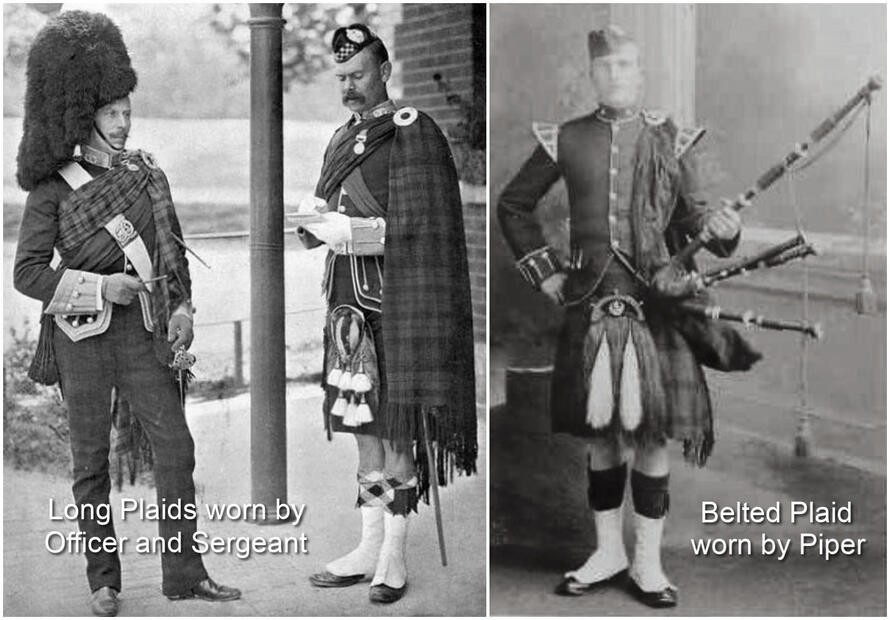
Here are "long plaids" (generally called "pipers plaids" despite never having been the unique domain of pipers) worn by the Colonel and a senior Sergeant, neither of them pipers (left) and a "belted plaid" (sometimes erroneously called a "fly plaid") worn, by of all things, a piper! (right).
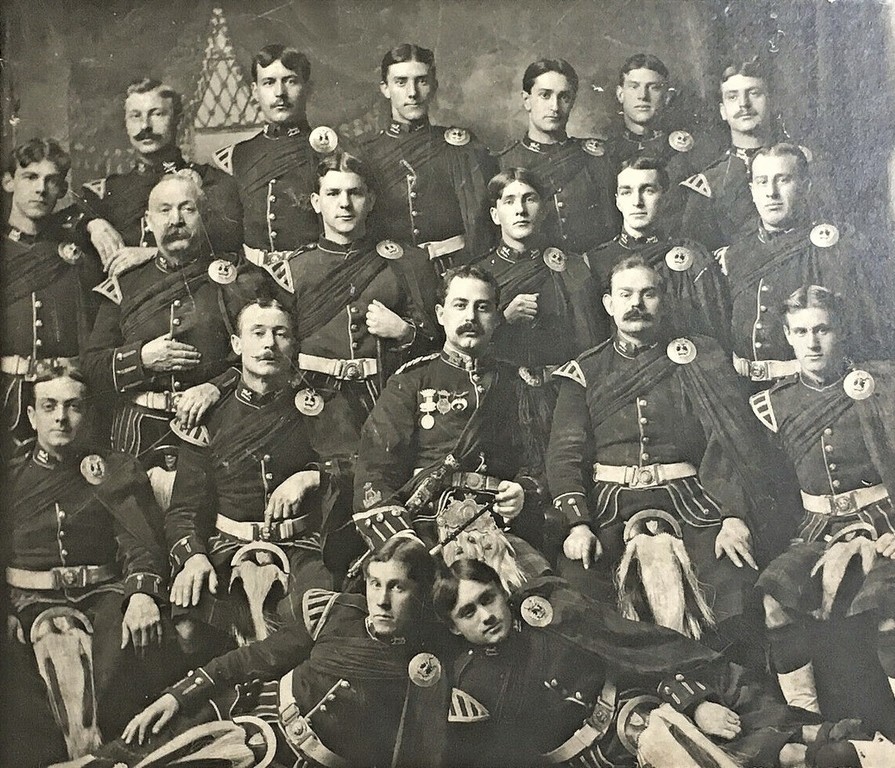
And the whole Gordon Highlanders military band, not a piper in sight, wearing Long Plaids. (Pipers can be told by their wide black leather Sword Belts and Dirk Belts.)
(The Bandmaster's sporran is amazing.)
Last edited by OC Richard; 6th December 25 at 10:37 PM.
Proud Mountaineer from the Highlands of West Virginia; son of the Revolution and Civil War; first Europeans on the Guyandotte
-
-
7th December 25, 04:01 AM
#36
Originally Posted by OC Richard
AFAIK the military "fly plaids" were the only sort of plaid not also worn in civilian Highland Dress.
The features that set them apart from "belted plaids" (worn in civilian Evening Dress, and by officers and others in the army) were less yardage, no fringe, and using ribbons (or a loop of cord) to attach to the left epaulette. ("Belted plaids" had purled fringe all around and were pinned with a brooch.)
I agree on both points.
-
-
7th December 25, 10:53 AM
#37
I take a couple of long plaids with me when off in the camper van and wear them much like the NCO in Figheadair's post.
They are useful if there is a brisk breeze as they stop the draught and keep the pleats from flying, but having been caught out once in a bad storm I was able to wind the plaid around over the kilt, then up over my head. I was soaked to the skin with water running off me, but wet wool is not cold - the fibres actually swell and make the fabric more windproof.
Half way back to the van I stopped to watch a couple of badgers playing in the water running down the gutters, so quite a memorable evening.
Back at the van I stripped off and wrapped myself in a great kilt before hanging up the wet things and drying my hair in a towel, still just fine and warm.
Next day I realised a lot of people had abandoned the festival due to the weather, but I had to make my way home last Friday in a similar storm, and I only had a man made fibre fleece blanket to put over my woollen coat - I got very cold. When I reached home I put on the great kilt which has been repurposed into a full length dressing gown for winter wear.
Several decades have passed since the storm with the badgers, so I am considerably older, but I am sure that I would have been less affected by the weather last Friday if I'd had two layers of wool rather than just one.
Anne the Pleater
I presume to dictate to no man what he shall eat or drink or wherewithal he shall be clothed."
-- The Hon. Stuart Ruaidri Erskine, The Kilt & How to Wear It, 1901.
-
-
8th December 25, 11:51 AM
#38
Originally Posted by Troglodyte
and you can then forget all about it until the end of the evening. This is when you find yourself running through the rain to find your car, and the benefit of a full-plaid is obvious - both to you and your lady who gets wrapped-up cosily at your side.
That's a nice image.
-
Tags for this Thread
 Posting Permissions
- You may not post new threads
- You may not post replies
- You may not post attachments
- You may not edit your posts
-
Forum Rules
|
|







 Reply With Quote








Bookmarks