|
-
9th April 14, 04:47 PM
#1
I may be wrong, but in an earlier post about your kilt pleats, it looked like your kilt was made of very light material. I remember some saying you may have a hip dimension issue with your kilt. Having the hip measurement too large will cause the material to hang like curtains with waves in it as you are forcing too much material below a set waist circumference. The material has to go somewhere, so it folds back in on itself in waves. Having too light weight material can have a similar effect, as the weight of the material will not pull down on itself enough to resist the lateral wave potential. Either of those issues or, worse yet, both issues combined and you have a problem no amount of pressing will cure.
Just want to be certain you are trying to fix the right problem.
Best of luck!
-
-
9th April 14, 05:42 PM
#2
-
The Following 2 Users say 'Aye' to The Wizard of BC For This Useful Post:
-
9th April 14, 07:17 PM
#3
Thanks, Mr. Wizard.
I'm pretty sure my problem is the hip dimensions. How difficult is this to fix? I certainly couldn't do it, but a local former member of the Black Watch and kiltmaker may be able to.
~Live Long and Piobaireachd~
Jordan "Grip" Langehennig
-
-
10th April 14, 05:00 AM
#4
The kilt cannot be repressed, it is simply too mirthful! 
All joking aside, if the waist is correct size I would imagine re-tapering is a possibility but a darned good bit of work...
"Everything is within walking distance if you've got the time"
-
-
10th April 14, 08:18 AM
#5
PiperofthePlains,
Please see this tutorial to determine if your kilt is the size you think it is.
http://www.xmarksthescot.com/forum/s...ad.php?t=81662
-
-
27th October 14, 09:32 AM
#6
I was watching 'how kilts are made' videos on you tube - the first one was how to make a 'Greatheart' kilt, but in mirror image with the long bit over the right shoulder, and the second one went on about the skilled workforce and showed the big press and the stick on stuff.
I had to retreat to my workroom and do some knitting on tiny needles.
Anne the Pleater :ootd:
I presume to dictate to no man what he shall eat or drink or wherewithal he shall be clothed."
-- The Hon. Stuart Ruaidri Erskine, The Kilt & How to Wear It, 1901.
-
The Following 2 Users say 'Aye' to Pleater For This Useful Post:
-
27th October 14, 09:48 AM
#7
 No eye poking Anne! No eye poking Anne!
I will fess up to using hem binding tape on things where I am too lazy to blind stitch. But never on a wool kilt. Nor on anything where a load or abrasion is involved. This includes trouser hems.
slàinte mhath, Chuck
Originally Posted by MeghanWalker,In answer to Goodgirlgoneplaids challenge:
"My sporran is bigger and hairier than your sporran"
Pants is only a present tense verb here. I once panted, but it's all cool now.
-
-
10th April 14, 01:32 PM
#8
 Originally Posted by The Wizard of BC

I happen to be basting a kilt in preparation of pressing so thought I would post some photos for you.
I hope these help.
If you just flop a kilt down on the table the Fell area, (That part in the back that is sewn down and tapered) will try to lay flat, but the pleats themselves will splay out.
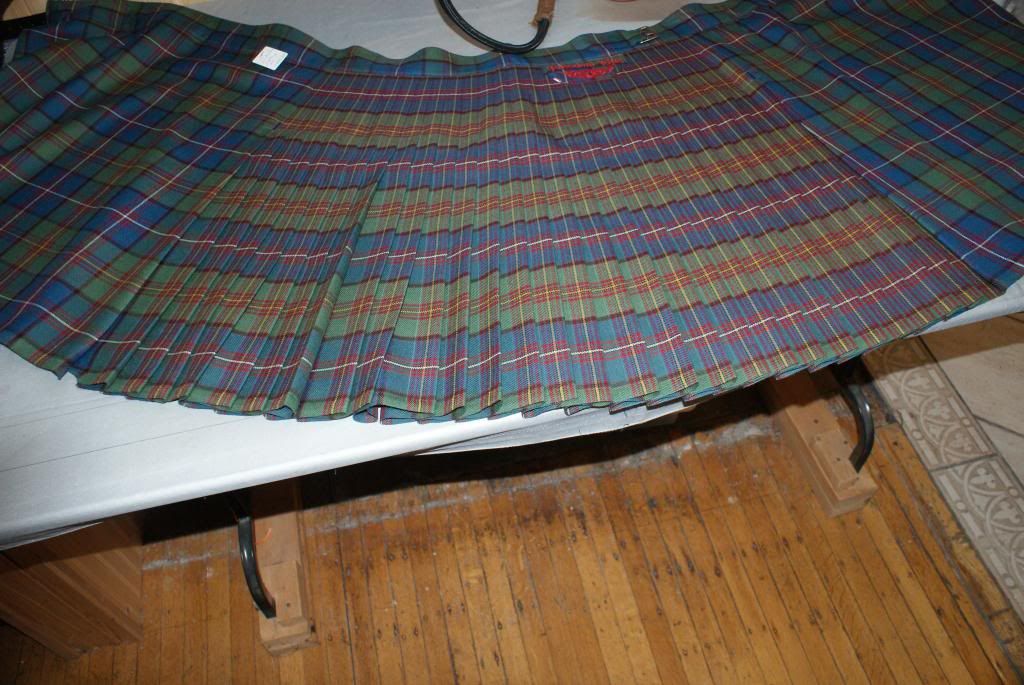
You should be able to see that the pleats are not the same width at the hem as they are up at the bottom of the Fell.
The waistband is taking that curve you mentioned.
To properly lay out a kilt for pressing you must insure that the pleats are the exact same width all the way down their length just as they are at the bottom of the Fell.So we lift the Fell area up till the pleats lay perfectly straight and
parallel
. 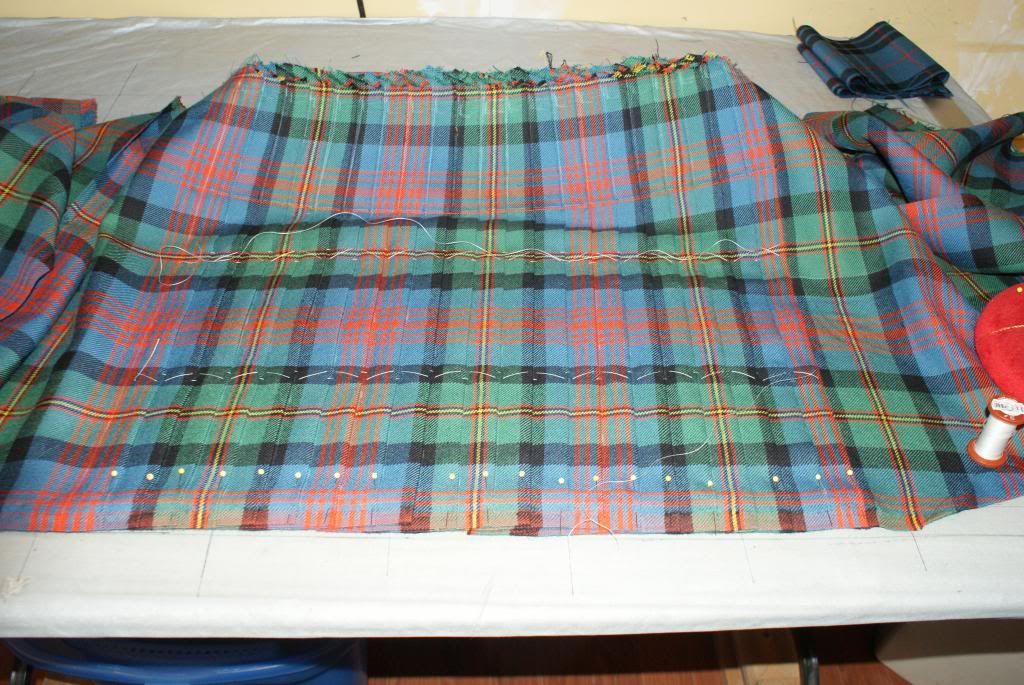
I have a rolled up kilt holding the Fell area up. This allows the pleats to lay flat
.Here you can see two lines of basting in place. The pleats are held parallel by the basting.And here you can see why we use basting thread instead of pins.
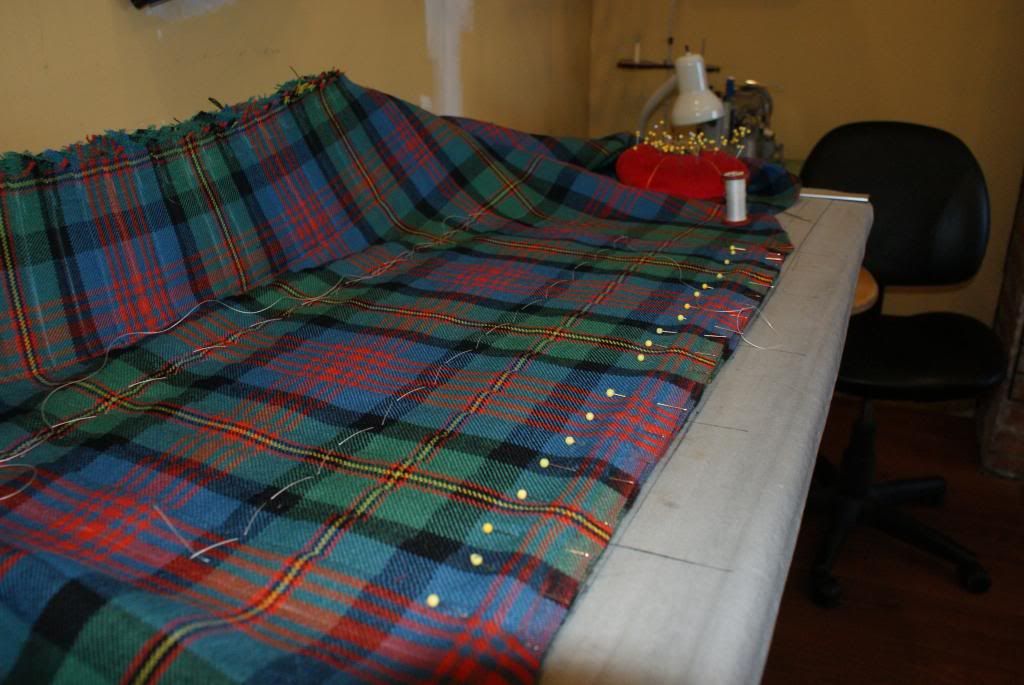
You should be able to see that the basting thread lays flat while at the pins there are pronounced bumps. If you were to try to press over the pins those bumps would be transferred to the pleats.
These two lines of basting took about 10 mins. to put in.
I'll now put in a third where the pins are and then PRESS, not iron. You use the heat of the steam to heat up the fabric. This softens the fibers.You then press straight down with pressure to set your creases. Then pick up your iron and move to the next spot.
And that, Ladies and Gents, is why he is THE WIZARD
Victoria
Just because you are paranoid doesn't mean they aren't out to get you.
-
-
10th April 14, 02:03 PM
#9
PiperofThePlains,
About having your Black Watch friend work on your kilt.
It will all depend on who made the kilt in the first place. If you kilt is made in the Regimental style that your kiltmaker learned, then yes, he could probably fix it.
If your kilt was made with a different method he may not know how to fix it.
All you can do is ask him.
-
-
10th April 14, 03:16 PM
#10
Originally Posted by Steve Ashton
PiperofThePlains,
About having your Black Watch friend work on your kilt.
It will all depend on who made the kilt in the first place. If you kilt is made in the Regimental style that your kiltmaker learned, then yes, he could probably fix it.
If your kilt was made with a different method he may not know how to fix it.
All you can do is ask him.
After he left the services, he was a kiltmaker. I'll see to asking him.
~Live Long and Piobaireachd~
Jordan "Grip" Langehennig
-
 Posting Permissions
- You may not post new threads
- You may not post replies
- You may not post attachments
- You may not edit your posts
-
Forum Rules
|
|














Bookmarks