






Now, How do you find or measure the size for your kilt jacket.
Almost all of the jackets you will find in Kilt Shops will be made in just a very few shops. So they will almost always be made using a very similar style or pattern.
Most kilt jackets will be made in a European style of cut. This means that the jacket will fit closer to your body than the average jacket in N.America.
At the side there will be a cut to taper the jacket into the waist. Not as much as a jacket cut in the "Italian" style but it is there.
This means that the waist of both the jacket and the vest will be smaller than the average N. American jacket.
For example a stock size 44 regular Argyle from one of the UK makers will have a chest of 44 inches. But the waist will be only 39 inches.
The back will have a more form fitting shape and may feel tighter under the arms that a N. American jacket. The same 44 Regular length kilt jacket will have only 9.75 inches from the back center seam to the arm hole.
This may mean that you cannot bring your arms forward and have the elbows touch as is normal in a N. American jacket.
So, if you have a waist near or larger than 39 inches you may have to go up a size in the chest. That is if your budget means you will be buying "Off-The-Rack". It is a fact that we here on X Marks sometimes forget when talking about jackets. Not everyone can afford a Made-To-Measure (MTM) or Custom/Bespoke jacket.
The secret really is to take a good set of measurements. You always do this with a flexible, tailors tape measure and forget the size you would normally buy in N. America.
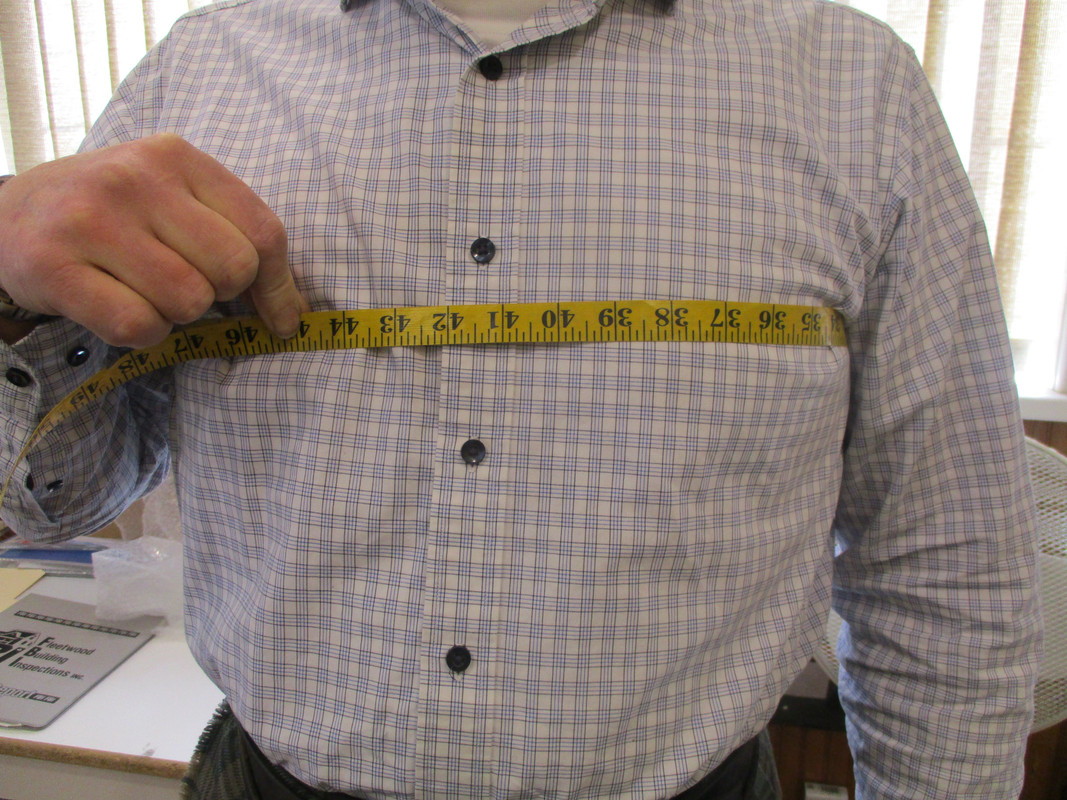
Measure the circumference just under the arms with the arms at the side and your body relaxed. Don't suck in your stomach or expand your chest.
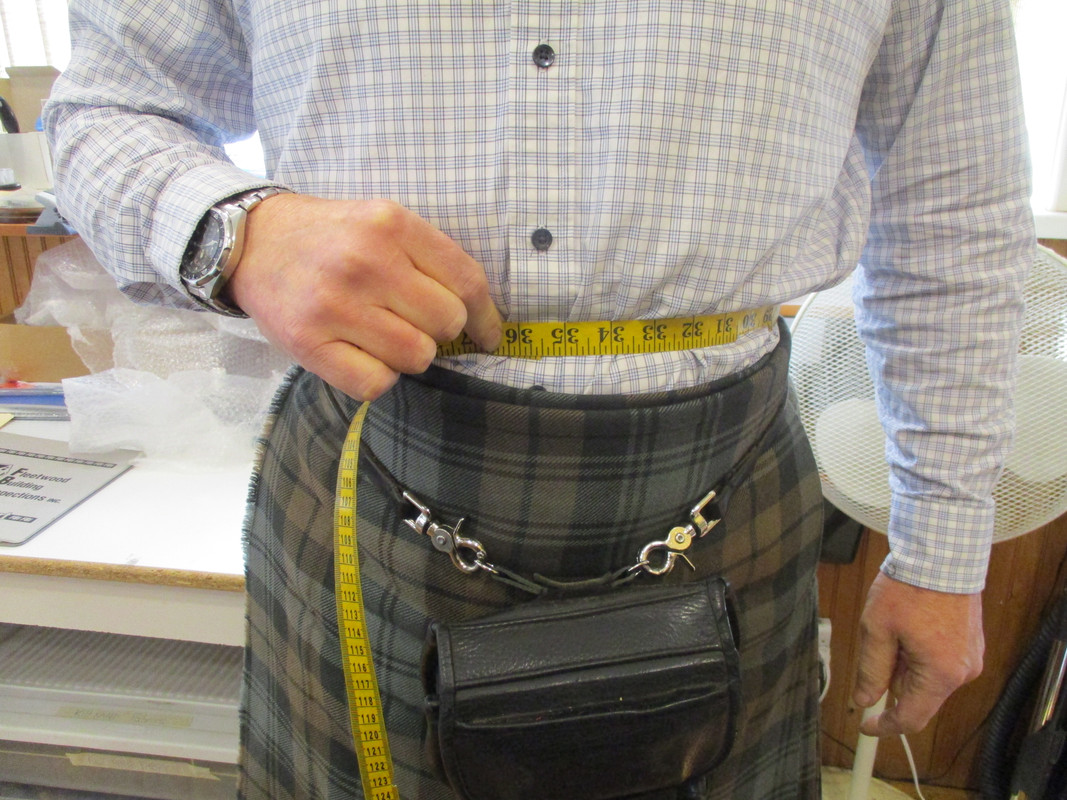
Then you will measure your waist. This is taken at the anatomical waist and not where you wear your trousers.
Put the tape measure just under the ribs at the side. Stand relaxed and don't suck in your stomach.
These first two circumference measurements you can easily do yourself. But for all the rest you will need an assistant.
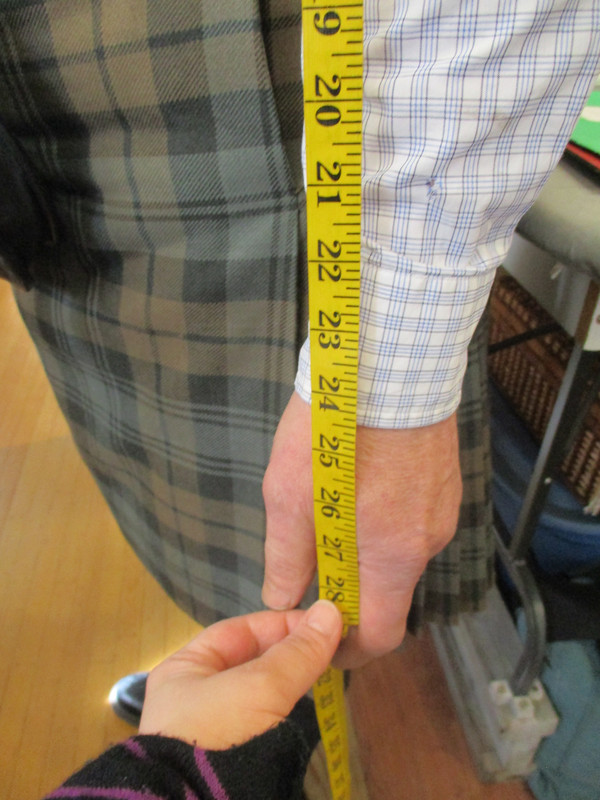
Determine where you want the cuff of your sleeve to hit your wrist. When I was young and learning about how to dress well, we were told that when your arms are down at you side there should be no shirt cuff showing. This is still how I wear my jackets today.
In the '60's this changed. Now it is common for a jacket cuff to be cut shorter so that about 1/2 inch of shirt cuff shows beyond the jacket cuff.
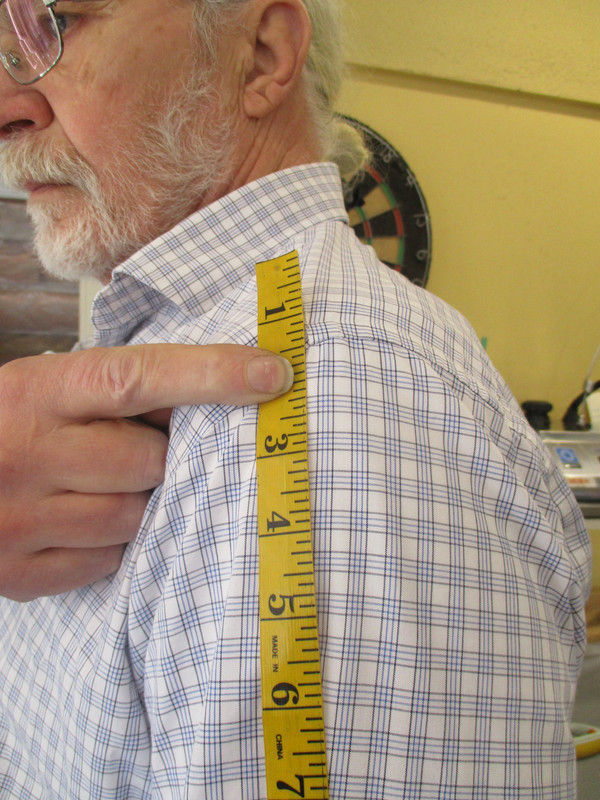
You are going to start at at the top of of your shoulder. You want to put the tape about 1 inch above the point where the shoulder joint is.
The go down to where ever you want your sleeve cuff to end.
You can actually use your shirt cuff to guide where the sleeve length (Called Crown-to- Cuff) measurement will be.
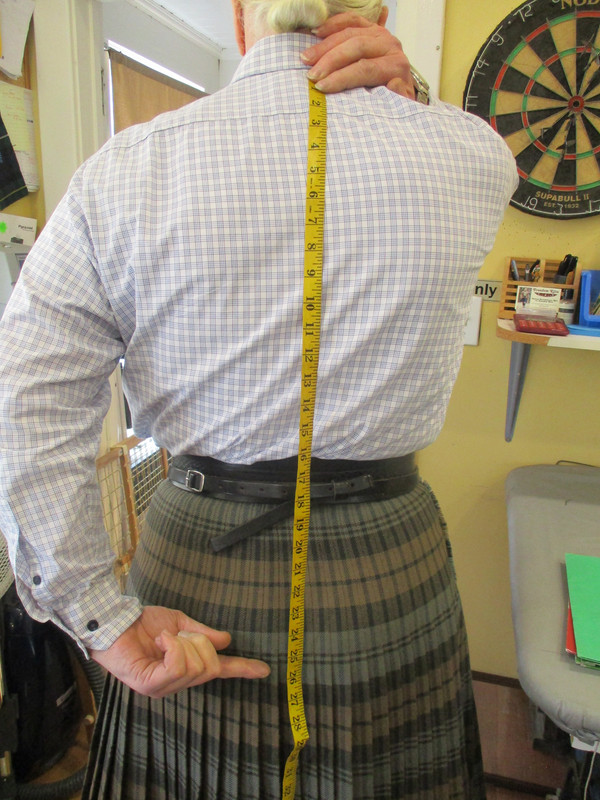
You will now need to find the length of the jacket.
This is taken with zero just below the collar.
And extends down the spine ending right at the crest of the buttocks.
A short length jacket will be 1 inch shorter in the jacket length and 1 1/2 inch shorter in the sleeve length.
A long length jacket will be 1 inch longer in the body and 1 1/2 inch longer in the sleeve.
For example - a Regular length 44 jacket will be 26 inches in length and have a 24.75 inch sleeve.
Add or subtract for a short or long length.
Now, the final measurement. And this is the hardest and most misunderstood measurement.
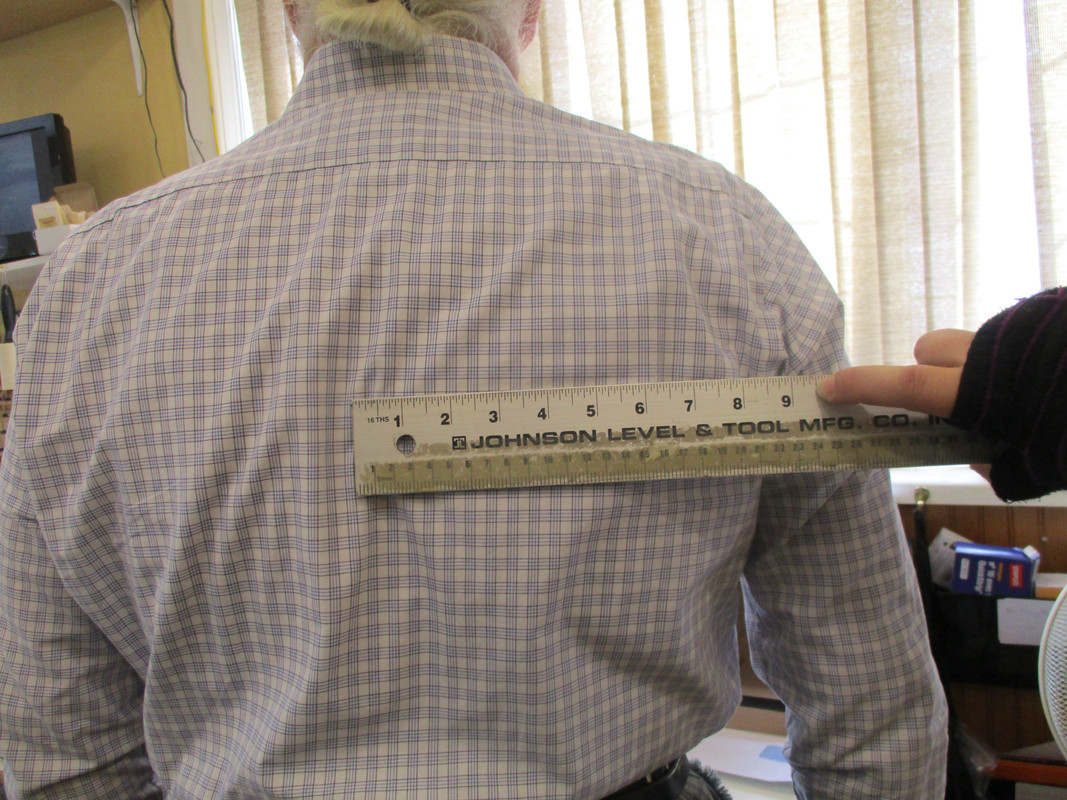
This is called the "Half-Back".
It is taken from the spine out to where the sleeve seam of a jacket will fit. It is not where a shirt seam will be so it is sort of hard to take accurately without a wearing a good fitting
jacket.
I find that it is easier to use a yardstick to measure for the half-back. Notice please where the finger is in this photo. That is the half-back.
If you find that you just will not fit in a stock size - and if your budget allows, - may I suggest that you at least explore a Made-To-Measure jacket. It will fit and feel much better than buying a size large stock jacket if you need extra room in the belly or under the arms.
If you are not able to visit the jacket maker or seller in person. If you are ordering on-line. May I strongly suggest that you include your height and weight and three photos.
One front on, one from the side and one from the back. This will allow the person on the other end to see the slope of your shoulders the posture of your back, and the relationship between your chest and stomach.







Bookmarks