|
-
4th July 26, 05:24 PM
#11
 Originally Posted by geomick

My Gaelic Themes tweeds are 48R, so if it doesn't fit (but really is a 48R) we can talk at the Waukesha games
Absolutely. See you then.
-
-
8th July 26, 03:26 AM
#12
Originally Posted by scratchy
Help my feeble color vision:
What 'kind' of green is it, i.e. lovat, Kelly, highland, bottle(not that I'd be able to tell the difference anyways)?
Hard for me to tell, I think it was "bottle" green.
EDIT:
I went back and looked at the original listing, and the semi-faraway shots of the whole jacket look much darker than the closeup shots of one cuff and of the label.
In the faraway shots it looks bottle green, while in the closeup shots it looks almost like what's sometimes called "Highland green".
Last edited by OC Richard; 8th July 26 at 04:36 PM.
Proud Mountaineer from the Highlands of West Virginia; son of the Revolution and Civil War; first Europeans on the Guyandotte
-
The Following User Says 'Aye' to OC Richard For This Useful Post:
-
8th July 26, 07:05 AM
#13
We shall find out when it gets here sometime next week 
If the size or color doesn't work out, it's not account wreckingly expensive. Fingers crossed.
-
-
8th July 26, 07:15 AM
#14
Originally Posted by OC Richard
Hard for me to tell, I think it was "bottle" green.
Ah, so I'm not the only one! Do most tweeds "change appearance" with the light? If it turns out to be Rolling Rock beer bottle green it may be a bit dark for my taste, but again we'll see.
-
-
8th July 26, 04:50 PM
#15
There's a lot of different greens with tweeds! And they end up getting called various things.
I'm trying to think of the ones I've seen.
Lovat Green: marled green and blue threads, a soft blue-ish green
Highland Green or Tartan Green: more or less the green seen in tartan
Moss: a light soft olive-tinged green
Feldgrau: I don't know what the Scottish makers call it, but it's not Lovat, not Moss, and exactly the colour that the German military calls Feldgrau
Bottle Green: a dark green like US 'forest green'
Archer Green: an extremely dark green that's often mistaken for black unless seen in strong light
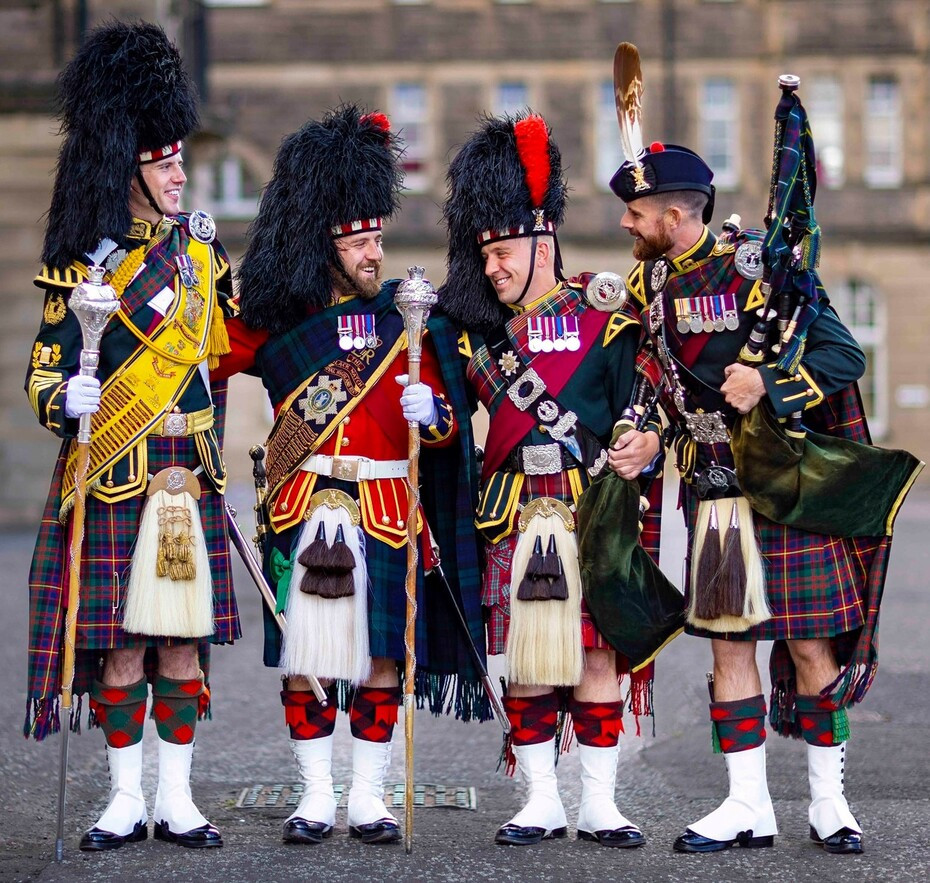
Here, three of the doublets are Archer Green
Last edited by OC Richard; 8th July 26 at 04:58 PM.
Proud Mountaineer from the Highlands of West Virginia; son of the Revolution and Civil War; first Europeans on the Guyandotte
-
-
Originally Posted by OC Richard
There's a lot of different greens with tweeds! And they end up getting called various things.
Archer Green: an extremely dark green that's often mistaken for black unless seen in strong light
Here, three of the doublets are Archer Green
I just checked. My electronics are pumping all the electrons they can muster to my monitor, yet I can't see the green. Certainly an endorsement for getting real fabric swatches before investing in a garment.
But I can't look at that photo without wondering just how LONG it takes those guys to dress for a performance! (Any guesses, or, better yet, informed answers?)
Having just acknowledged how important it is to check real FABRIC when selecting a tweed, I'll still drop a couple JPEGS here to solicit opinions regarding pairing one of these (from Lovat Mills), in an Argyll + lapelled waistcoat with a Glen Affric kilt:
Thanks SO MUCH!
-
-
Originally Posted by jsrnephdoc
I just checked. My electronics are pumping all the electrons they can muster to my monitor, yet I can't see the green. Certainly an endorsement for getting real fabric swatches before investing in a garment.
But I can't look at that photo without wondering just how LONG it takes those guys to dress for a performance! (Any guesses, or, better yet, informed answers?)
Having just acknowledged how important it is to check real FABRIC when selecting a tweed, I'll still drop a couple JPEGS here to solicit opinions regarding pairing one of these (from Lovat Mills), in an Argyll + lapelled waistcoat with a Glen Affric kilt:
Thanks SO MUCH!
If I were to pair a tweed jacket with that tartan, I wouldn't choose a tweed from a nearby color way. In my estimation it would be like putting beige and tan together. With the Glen Affric hues, I'd go for a Lovat or moss green to present a contrast but keep with earth tones. I look forward to seeing what you choose.
-
The Following User Says 'Aye' to PiperPadre For This Useful Post:
-
Fabric choices
To my eye the first sample looks like a lovely choice providing the hues are as dark in the tweed as they appear in the jpeg.
Contrast could come from some blue hose and your choice of tie and shirt.
-
-
Originally Posted by jsrnephdoc
I can't look at that photo without wondering just how LONG it takes those guys to dress for a performance! (Any guesses, or, better yet, informed answers?)
It takes a while! The first Pipe Band I played in, in the 1970s, wore that full kit for performances and we got pretty efficient at getting dressed.
Buttoning up the spats is a bit of a pain. (They have spats with false buttons and hidden velcro but these never look quite right.)
The most difficult part is putting on the plaid. It's tough to do it well by yourself, so generally you have somebody help you.
Here's an ex-Scots Guards piper demonstrating the Scots Guards method of putting on the plaid.
https://www.youtube.com/watch?v=E1XGDB8EtNI&t=10s
I learned a completely different method. In our band was an ex-Cameron Highlander (WWII) so presumably our method was the Cameron Highlanders way.
Last edited by OC Richard; Today at 03:16 AM.
Proud Mountaineer from the Highlands of West Virginia; son of the Revolution and Civil War; first Europeans on the Guyandotte
-
-
Originally Posted by jsrnephdoc
...opinions regarding pairing one of these in an Argyll + lapelled waistcoat with a Glen Affric kilt.
Personally I would first look at tweeds that contrast and coordinate with the kilt rather than match it.
In a Highland outfit you have three major, and relatively equal, blocks of colour jacket/kilt/hose.
The most striking outfits result from these three blocks of colour contrasting and coordinating rather than matching, though for sure it was considered standard from the 1920s through the 1960s to have the tweed of the jacket match, or at least "tone with", the hose.
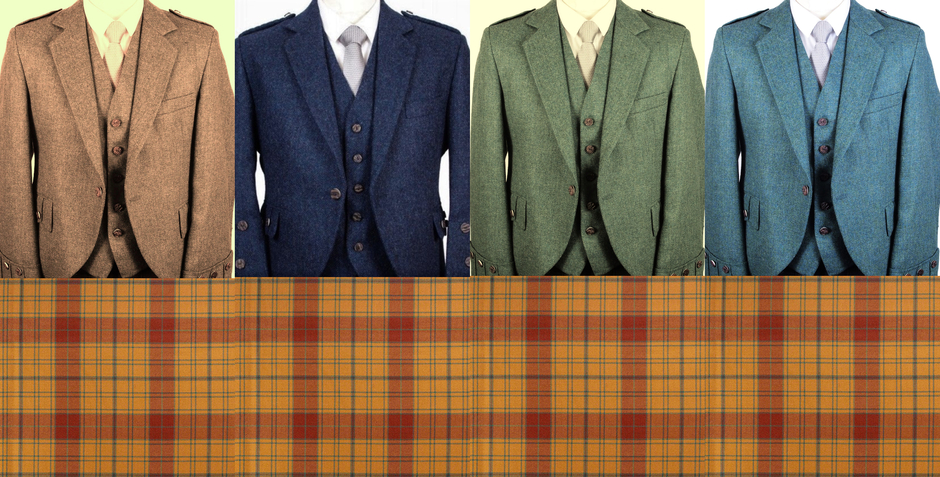
Without even looking I would think that the most striking tweed for a yellow-tan kilt would be blue.
Here's a quick collage of Glen Affric with four different jacket colours, this confirms that blue works well, really coordinating with the yellow. From this lineup I'd go with the Lomond Blue, though in truth all of them work fine.
Last edited by OC Richard; Today at 04:18 AM.
Proud Mountaineer from the Highlands of West Virginia; son of the Revolution and Civil War; first Europeans on the Guyandotte
-
The Following User Says 'Aye' to OC Richard For This Useful Post:
 Posting Permissions
- You may not post new threads
- You may not post replies
- You may not post attachments
- You may not edit your posts
-
Forum Rules
|
|





 Reply With Quote




Bookmarks