|
-
20th April 10, 11:41 PM
#1
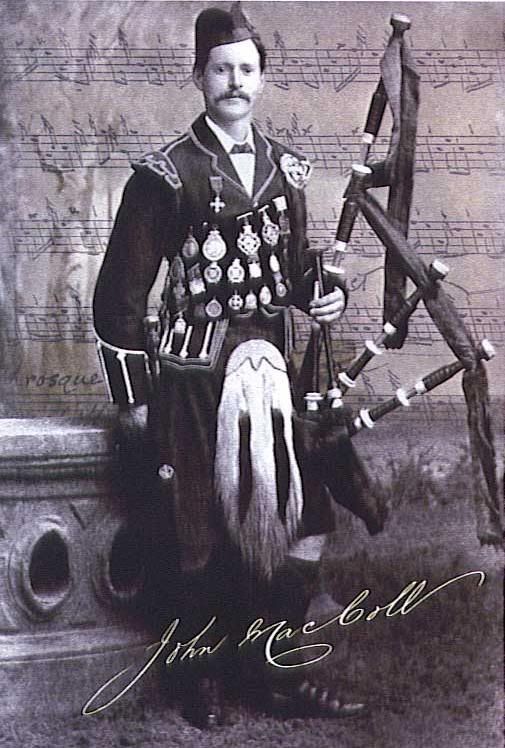
John MacColl (1860-1943)
Seven of the greatest competition 2/4 marches –Mrs, John MacColl, Jeannie Carruthers, The Argyllshire Gathering, Arthur Bignold of Lochrosque, The Clan MacColl, Dugald MacColl’s Farewell to France and John MacFadyen of Melfort – all came from the fertile composing mind of John MacColl, one of the greatest figures from what is often regarded as piping’s ‘Golden Age.’
His greatness stems from more than just his compositions. The 4th son of Dugald MacColl, a tailor and an excellent piper from Kentallen, he distinguished himself from his piping brothers by a desire not just to do well, but to be the best. He would excel not just at composing, but as a piper, a fiddler, a Highland dancer and an athlete.
Instruction came initially from his father, and then from the famous pipe music editor and player Donald MacPhee (1841-1880) and finally from Pipe-Major Ronald MacKenzie of the Black Watch (1842-1916), who won the Prize Pipe at Inverness in 1873, the Gold Medal there in 1875 and died in 1911. His initial forays into competitive piping starting when he was 17 in 1877 were not particularly successful. He was competing against piping immortals like Robert Meldrum and John MacDougall Gillies and success was not immediate. But in 1880 he became piper to MacDonald of Dunach and was able to devote his life to piping. He won the Gold Medal at Oban the next year, the Prize Pipe at Inverness in 1883, the Former Winners’ Gold Medal at Inverness in 1884, the Clasp at Inverness in 1900 and first prize at the Paris Exhibition in 1902.
A professional piper, he competed everywhere, but not just in the piping. His son John once wrote of his father:
“He did tell me of finishing a dance, throwing off his kilt (having running shorts underneath) competing in the hundred yards race and then putting his kilt and things on ready for the next dance. This, of course, was just as a professional to augment his prize money for the day. Naturally his major earnings came from playing the pipes, dancing and teaching.”
Unlike today, the games circuit was lucrative for one so versatile, and the ability to earn £40 in an afternoon in the late 1800s afforded him the leisure to pursue yachting, golf, shinty, fiddling, Gaelic singing and composing.
He served as pipe-major of the 3rd Battalion of the Black Watch and after that with the Scottish Horse. He trained pipers and taught piobaireachd for the Piobaireachd Society.
Around the turn of the century he, Willie Lawrie and G. S. McLennan revolutionized the composition of light music, and in particular took the competition march form to a level that has not been equalled.
His piobaireachd playing received mixed reactions. He won the major prizes, but never dominated the piobaireachd lists as he could in the light music, where he was considered the best march player of the time. Some thought his piobaireachd playing lacked the expressive feeling of his light music, but John MacDonald of Inverness called one of his performances of “I Got a Kiss of the King’s Hand” at Birnam Games “one of the most harmonious performances I have ever listened to.” He composed three piobaireachd, two of which (Lament for Donald MacPhee and N.M. MacDonald’s Lament) won composing contests, and the third of which has been lost.
In 1908 he gave up the games circuit and joined the Glasgow firm of R. G. Lawrie as the manager of their new bagpipe making branch. John MacDougall Gillies was similarly in charge of Henderson’s shop, and as a result, some of the greatest sets of pipes ever made came from these two firms during this time. MacColl retired from Lawrie’s in 1936. During those first few decades of the 1900s, he and MacDougall Gillies – who died in 1925 – helped build the Glasgow piping community into a centre of piping excellence that has continued to this day.
John MacColl died on June 8, 1943. John MacDonald of the Glasgow Police played Lament for the Children at his funeral.
http://www.pipetunes.ca/composers.as...&composerID=19
[SIZE="2"][FONT="Georgia"][COLOR="DarkGreen"][B][I]T. E. ("TERRY") HOLMES[/I][/B][/COLOR][/FONT][/SIZE]
[SIZE="1"][FONT="Georgia"][COLOR="DarkGreen"][B][I]proud descendant of the McReynolds/MacRanalds of Ulster & Keppoch, Somerled & Robert the Bruce.[/SIZE]
[SIZE="1"]"Ah, here comes the Bold Highlander. No @rse in his breeks but too proud to tug his forelock..." Rob Roy (1995)[/I][/B][/COLOR][/FONT][/SIZE]
-
-
20th April 10, 11:57 PM
#2
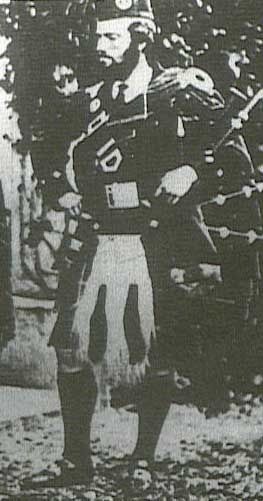
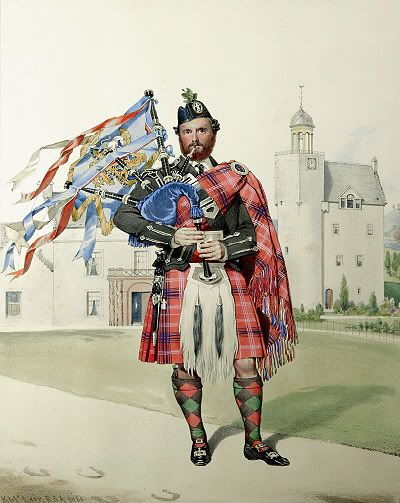
William MacDonald (1843 - ?)
Known as the composer of "Leaving Glenurquhart" (originally known as "Tulloch MacCarrick"), William MacDonald was the brother of Alexander MacDonald, who was the father of John MacDonald of Inverness, and Duncan MacDonald.
He was born in Easgart, in Glenurquhart and taught by Donald Cameron and Duncan MacKay. He was described as a foremost piper of his day and won the Gold Medal at Inverness in 1869. He was piper to MacPherson of Glentruim for two year, and in 1965 was appointed piper to the Prince of Wales at Abergeldie. "Tulloch MacCarrick" was a farm near Balmoral, whose tenant was a lover of pipe music and who frequently hosted notable pipers visiting Balmoral Castle.
Like many of his day, MacDonald played on the right shoulder.
Though he was said to be a quiet, unassuming man, he was seized with religious zeal later in life and reportedly destroyed his pipes and swore off all music.
William MacDonald as the piper to the Prince of Wales in 1867.
William MacDonald as painted by Kenneth MacLeay
http://www.pipetunes.ca/composers.as...composerID=137
[SIZE="2"][FONT="Georgia"][COLOR="DarkGreen"][B][I]T. E. ("TERRY") HOLMES[/I][/B][/COLOR][/FONT][/SIZE]
[SIZE="1"][FONT="Georgia"][COLOR="DarkGreen"][B][I]proud descendant of the McReynolds/MacRanalds of Ulster & Keppoch, Somerled & Robert the Bruce.[/SIZE]
[SIZE="1"]"Ah, here comes the Bold Highlander. No @rse in his breeks but too proud to tug his forelock..." Rob Roy (1995)[/I][/B][/COLOR][/FONT][/SIZE]
-
-
21st April 10, 12:05 AM
#3
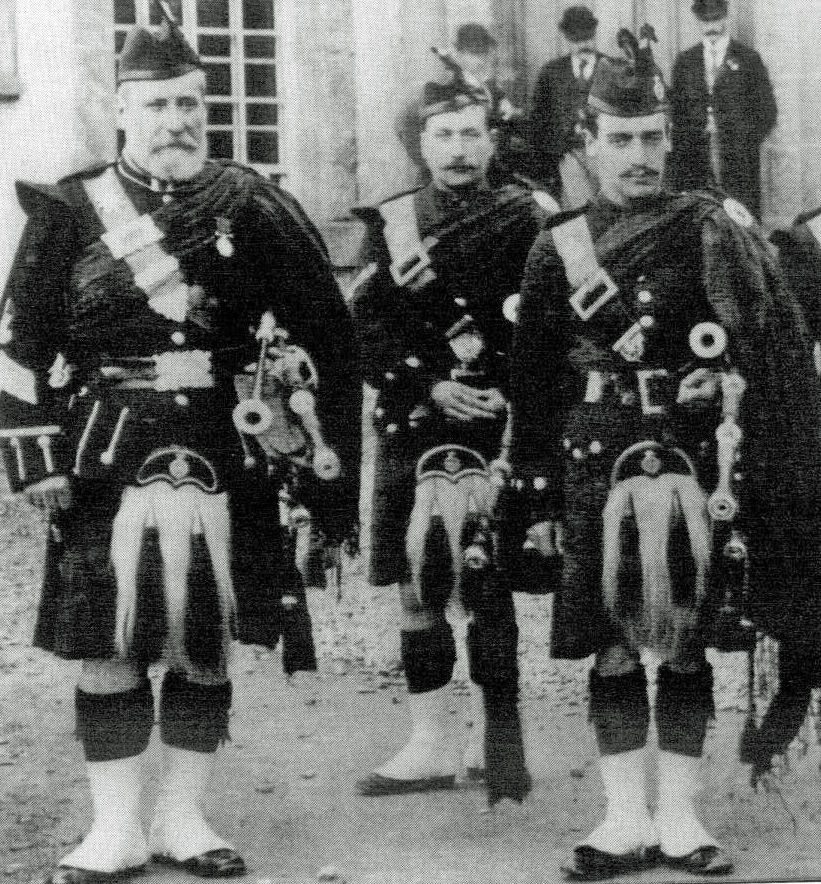
Duncan MacDougall (1837-1898)
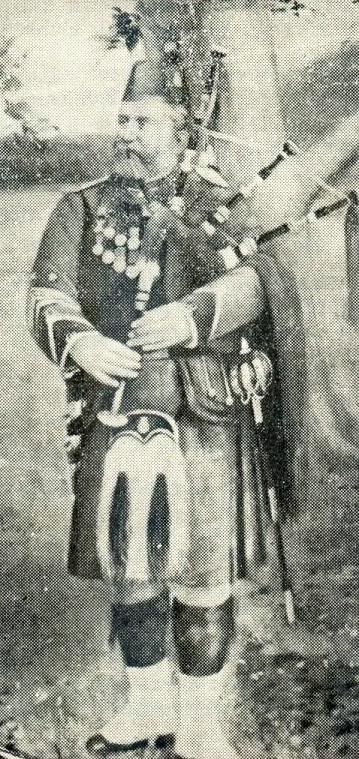
Today, Duncan MacDougall is remembered as perhaps the premier pipemaker of his time. Few realize he was also the best piper of his generation.
He was born in Perth into a pipemaking family, his grandfather Allan having begun a pipemaking firm in 1792, and his father John taking it over around 1834. Duncan took the business over in Perth in 1857 and moved it to Edinburgh around 1861. He became pipe major of the Edinburgh Volunteers and instructor to the Black Watch volunteers. He had already begun making a name for himself as a competitor as early as age 17 when he won a first place for piobaireachd at Montrose games among some of the leading players of the day....
(read more here)
Pipe Major Duncan MacDougall (left), with sons John and Gavin (right) with the 2nd Perthshire Highland Rifle Volunteers in 1896.
[SIZE="2"][FONT="Georgia"][COLOR="DarkGreen"][B][I]T. E. ("TERRY") HOLMES[/I][/B][/COLOR][/FONT][/SIZE]
[SIZE="1"][FONT="Georgia"][COLOR="DarkGreen"][B][I]proud descendant of the McReynolds/MacRanalds of Ulster & Keppoch, Somerled & Robert the Bruce.[/SIZE]
[SIZE="1"]"Ah, here comes the Bold Highlander. No @rse in his breeks but too proud to tug his forelock..." Rob Roy (1995)[/I][/B][/COLOR][/FONT][/SIZE]
-
-
21st April 10, 12:10 AM
#4
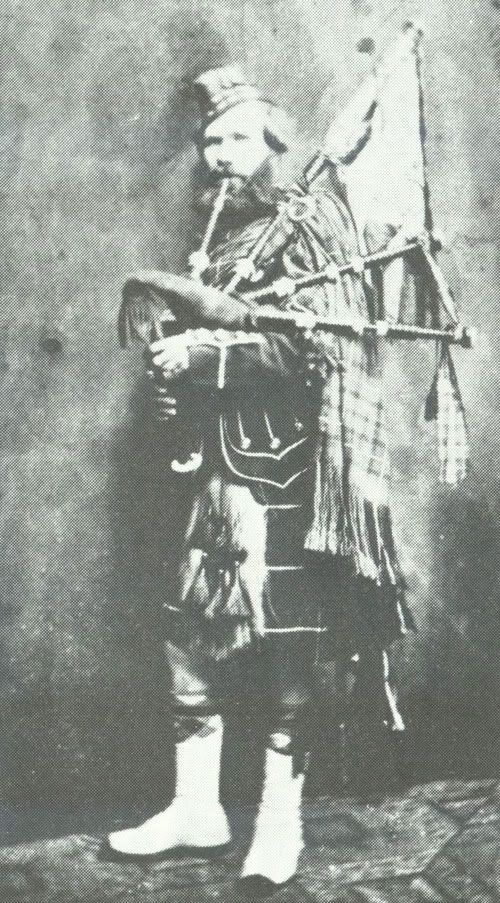
Alexander MacKellar (circa mid-1800s)
Little appears to be known about the composer of "The Barren Rocks of Aden."
C. A. Malcolm's 1927 publication, The Piper in Peace and War, says he was Pipe Major of the 78th (Ross-shire Buffs) from 1853-1862, including during the Indian Mutiny (1857).
He is known primarily for the first two parts of one of the most popular pipe tunes ever.
http://www.pipetunes.ca/composers.as...composerID=146
[SIZE="2"][FONT="Georgia"][COLOR="DarkGreen"][B][I]T. E. ("TERRY") HOLMES[/I][/B][/COLOR][/FONT][/SIZE]
[SIZE="1"][FONT="Georgia"][COLOR="DarkGreen"][B][I]proud descendant of the McReynolds/MacRanalds of Ulster & Keppoch, Somerled & Robert the Bruce.[/SIZE]
[SIZE="1"]"Ah, here comes the Bold Highlander. No @rse in his breeks but too proud to tug his forelock..." Rob Roy (1995)[/I][/B][/COLOR][/FONT][/SIZE]
-
-
21st April 10, 12:16 AM
#5
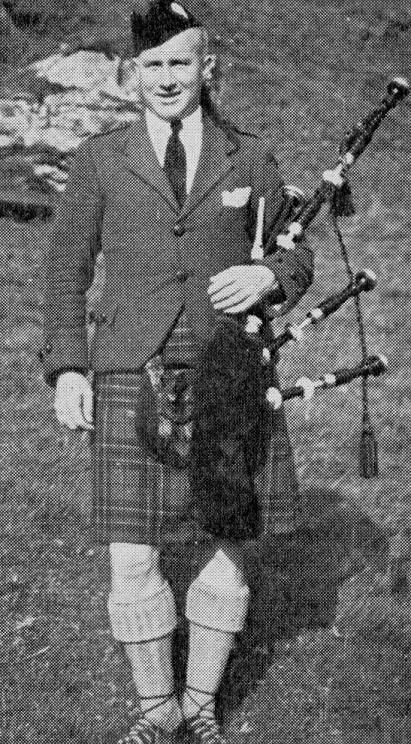
Pipe Major Donald MacLean (1908-1964)
This larger-than-life piping character was known variously as “Big Donald MacLean” and “Donald MacLean of Lewis,” as recalled in Donald MacLeod’s popular 6/8 march. References in piping books to “Pipe Major Donald MacLean” are generally to him.
Born in 1908, his interest in the pipes began in 1916 when his older brother Murdo took up the instrument to help in the recovery of a lung wound suffered in the Great War. Donald borrowed his brother’s chanter and soon both were being taught by Peter Stewart of Barabhas.
(read more here)
[SIZE="2"][FONT="Georgia"][COLOR="DarkGreen"][B][I]T. E. ("TERRY") HOLMES[/I][/B][/COLOR][/FONT][/SIZE]
[SIZE="1"][FONT="Georgia"][COLOR="DarkGreen"][B][I]proud descendant of the McReynolds/MacRanalds of Ulster & Keppoch, Somerled & Robert the Bruce.[/SIZE]
[SIZE="1"]"Ah, here comes the Bold Highlander. No @rse in his breeks but too proud to tug his forelock..." Rob Roy (1995)[/I][/B][/COLOR][/FONT][/SIZE]
-
-
21st April 10, 12:24 AM
#6
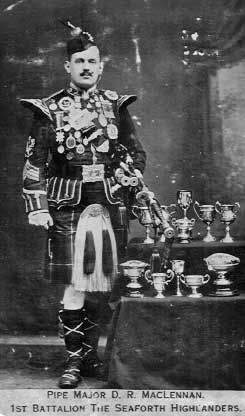
Donald Ross ("D.R.") MacLennan (1901-1984)
D. R. MacLennan was born in Edinburgh in 1901, son of Lieutenant and Edinburgh Police Superintendent John McLennan, well known authority on pipe music and one of the most prominent piping figures of the day.
D. R. was a younger half-brother of G. S. McLennan and a cousin to the almost equally famous Highland dancer and piper William McLennan. Originally taught pipes by his father, he was later a pupil of Willie Ross and John MacDonald of Inverness.
He enlisted in the Scots Guards in 1919, but transferred in 1925 to the Seaforth Highlanders at Fort George, where he was named Pipe Major of the 1st Battalion. He would hold this post for 13 years. He returned to Fort George in 1938 and spent the war years as Regimental Sergeant Major of the Infantry Training Centre until he was commissioned into the Seaforths. He retired as a Captain in 1948.
He won prizes as a piper, dancer and athlete early in his career, though he would not win the premier prizes until 1956, having been talked into returning to the competition platform by friends a few years earlier. He justified their faith in him by achieving the extraordinary feat of winning the Gold Medals at Oban and Inverness in the same year at the age of 55.
He contributed to the 1935 production of The Standard Settings of the Seaforth Highlanders, perhaps the most popular collection of its day until it was eclipsed by the first Scots Guards collection in 1954....
(read more here)
[SIZE="2"][FONT="Georgia"][COLOR="DarkGreen"][B][I]T. E. ("TERRY") HOLMES[/I][/B][/COLOR][/FONT][/SIZE]
[SIZE="1"][FONT="Georgia"][COLOR="DarkGreen"][B][I]proud descendant of the McReynolds/MacRanalds of Ulster & Keppoch, Somerled & Robert the Bruce.[/SIZE]
[SIZE="1"]"Ah, here comes the Bold Highlander. No @rse in his breeks but too proud to tug his forelock..." Rob Roy (1995)[/I][/B][/COLOR][/FONT][/SIZE]
-
-
21st April 10, 12:30 AM
#7
David Charles ("D.C.") Mather (1870-1943)
Known to pipers as “D.C. Mather,” this prolific composer was born in London, where he attended the London Caledonian School being taught by John MacKenzie (c. 1831-1904), who was a nephew of John Ban MacKenzie and who won the Prize Pipe at Inverness in 1874 and the Gold Medal there in 1876.
Mather was later taught by Robert Meldrum and John MacDougall Gillies. He served at various times as piper to MacDougall of Lunga, Admiral Campbell of Craignish and the Murrays of Lochcarron.
He died in Montana, having moved to the U.S. by way of Canada in 1901 to prospect for gold.
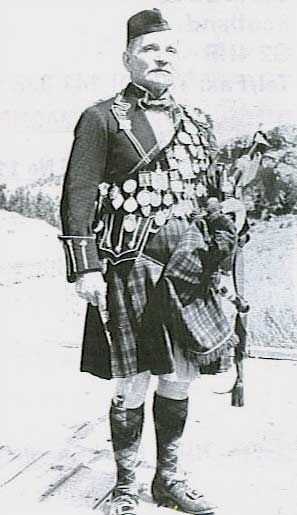
Thought of usually as a composer, he was a successful competitor and all-rounder as well, competing in Highland dancing and athletic events. He won the Gold Medal at Oban in 1891 and at the Prize Pipe at Inverness in 1899. He continued to compete in North America well into his 60s, and the photo shows him at his mining claim in Montana bedecked in awards in 1936.
Among his most popular compositions are the reels Loch Carron, Willie Cummings Rant and The Man from Glengarry, the strathspey Climbing Dunaquaich and the competition march The Stornoway Highland Gathering.
D.C. Mather in Montana, 1936
http://www.pipetunes.ca/composers.as...&composerID=25
[SIZE="2"][FONT="Georgia"][COLOR="DarkGreen"][B][I]T. E. ("TERRY") HOLMES[/I][/B][/COLOR][/FONT][/SIZE]
[SIZE="1"][FONT="Georgia"][COLOR="DarkGreen"][B][I]proud descendant of the McReynolds/MacRanalds of Ulster & Keppoch, Somerled & Robert the Bruce.[/SIZE]
[SIZE="1"]"Ah, here comes the Bold Highlander. No @rse in his breeks but too proud to tug his forelock..." Rob Roy (1995)[/I][/B][/COLOR][/FONT][/SIZE]
-
Similar Threads
-
By Big Paul in forum How to Accessorize your Kilt
Replies: 11
Last Post: 3rd October 07, 06:21 PM
-
By angerli in forum General Kilt Talk
Replies: 17
Last Post: 1st February 07, 02:13 PM
-
By cessna152towser in forum Show us your pics
Replies: 3
Last Post: 22nd May 06, 05:25 PM
Tags for this Thread
 Posting Permissions
- You may not post new threads
- You may not post replies
- You may not post attachments
- You may not edit your posts
-
Forum Rules
|
|









Bookmarks