|
-
20th December 06, 03:10 PM
#11
Disregarding the comments re: modern Highland Games, the article about the belted plaid itself is quite accurate, including the time-frame mentioned. The picture is a tad goofy (especially the gauntlets, and whatever that is wrapped around his hose!) but it could very well represent a mid-17th C. clansman wearing a typical doublet (usually made of wool, not leather) and a belted plaid....
Brian
"They who can give up essential liberty to obtain a little temporary safety, deserve neither liberty nor safety." ~ Benjamin Franklin
-
-
20th December 06, 03:51 PM
#12
Here is a link to Wikipedia hoaxes
http://en.wikipedia.org/wiki/Wikipedia_hoax
There have been many. I dont think the author meant any harm from the article.
If you belive that that you need to then by all means edit the page, and let us know when you have it would be nice to see the differences.
-
-
20th December 06, 04:15 PM
#13
In Defense of Wikipedia,
I have it listed as a favorite and often use it as a first step when I am looking something up. I have found many useful links on Wikipedia that have led me to what I was looking for, including X Marks the Scot. I certainly wouldn't recomend using it as a sole source of information, or treating it as a final word on any subject. But I still find it a very useful resource.
Someone here once mentioned that the information on the internet is a vast ocean, but sadly one that is only on average an inch deep. With most information on the internet, your best bet is to find additional sources to check any information you glean.
Cheers
Last edited by Panache; 20th December 06 at 06:37 PM.
-See it there, a white plume
Over the battle - A diamond in the ash
Of the ultimate combustion-My panache
Edmond Rostand
-
-
20th December 06, 05:44 PM
#14
So what exactly is wrong with the wiki?
I looked and I do not see any tremendous mistakes here.
So what exactly is wrong, I don't get it.
-
-
20th December 06, 06:18 PM
#15
 Originally Posted by beloitpiper

Also, they refer to this:
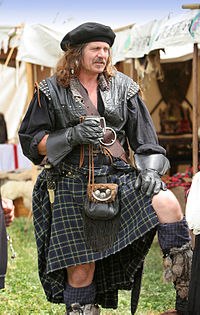
as a "Historical re-enactor"
What are your thoughts?
I edited it. It now says what he truly is - a Renaissance Faire attendee.
Virtus Ad Aethera Tendit
-
-
20th December 06, 06:39 PM
#16
I have used Wikipedia many times during my research papers, BUT I only use the information when it seems credible, as in I cross referenced the bulk of the material with something else. If most everything else matches up, you can occasionally get bits of information from there that is harder to find elsewhere. Sometimes, the person who put the article in there may have had experience in the field. It is always used as a supplemental source, never a main one though.
-
-
20th December 06, 06:57 PM
#17
The only thing I'll pretty much take "as is" from Wikipedia is information on wrestlers... because if I'm wrong, it doesn't make a bit of difference...
-
-
20th December 06, 07:53 PM
#18
Originally Posted by Captain
The only thing I'll pretty much take "as is" from Wikipedia is information on wrestlers... because if I'm wrong, it doesn't make a bit of difference...
Maybe I should write an article about MYSELF!
"MacWage:------":rolleyes:
-
-
20th December 06, 08:03 PM
#19
Originally Posted by MacWage
Maybe I should write an article about MYSELF!
"MacWage:------":rolleyes:
It wouldn't be the first time, nor the last. But if you do, others might edit to to quote authoritative sources that your feet stink, etc.
-
-
8th January 07, 06:47 PM
#20
I think the contempt some people hold for Wikipedia is funny. It's very much en-vogue these days to scornfully pooh-pooh internet sites, but with regard to Wikipedia I've found that people would rather complain that it's inaccurate than take a little time to fix the entries they find fault with. Anyway, personally I think reports of its inaccuracy are exaggerated. For one thing the people finding fault are no more likely to have their facts straight than are the people contributing articles to Wikipedia. Plus, I've found that in areas where I'm knowledgeable it has often been as accurate as online encyclopedias that I'd pay big $$ for and where it's inaccurate it's in details that really don't matter for the purposes I'm using it for. Then there's the fact that it's completely free. What should we expect from a free resource? Short answer - nothing, because it's free!
Personally I use Wikipedia a lot. It's relatively accurate in general and it gives informative links, so it's a great place to start research and a great place to look when you want to know simple info like who someone is (i.e. who is John Lydon) or what something is (what is a MacPherson strut). Do I need perfect info at that point in my research? No. I need a general overview and Wikipedia does at least as well as The History Channel in terms of getting its facts right.
In short, I have two options: I can look online at Wikipedia and get reasonably good general info or I can go downstairs and access my Encyclopedia Britannica and get well researched hard data. Since finding Wikipedia I've accessed it hundreds of times. Since that time, how many times have I needed to open the Britannica for more detailed and more certain info? Not once. Draw your own conclusions.
Also, Wikipedia can only get more accurate as more people (and more knowledgeable people) contribute. But as long as people are complaining about it rather than fixing it, it's only going to be as good as the willingness of the community to stop whining about it and make a positive change. After all, it's not as if it's hard to alter. If Wikipedia is flawed it's flawed because the public's preference for complaining and poking fun is only matched by its unwillingness to make positive change.
In terms of whether the guy in the picture is a historical reenactor or a Renaissance Faire attendee, well does it really matter? Historical reenactors are often not much more accurately attired than Ren Faire folks. Historical reenactments are often the grown-up equivalent of playing army (and I should know, since I'm a reenactor myself - I've been one since about 1995). In my experience with WWI reenacting at the biggest WWI site in the US the participants usually don't know how to wear their clothes (they often button their clothes in an unhistorical fashion), they don't know how WWI era people spoke, they don't know how to properly man a trench, they don't know how to advance across open ground or how to perform a trench raid, the organizers of the event build trenches too close to one another (so close that a man in the Allied forward trenches can often lob a grenade into the enemy forward trench - something that would never havbe been allowed to continue in real life), they can't tell a fire trench from a traverse or a parapet from a parados, and they build dugouts with their entrances uncovered and facing the enemy line. In short, WWI reenactors have the historical sense of a 5 year-old child. I have reason to believe that this level of ignorance is widespread throughout the reenacting community. I wouldn't trust most reenactors to accurately recreate a modern bring and buy sale.
Last edited by Beery; 8th January 07 at 07:20 PM.
-
Similar Threads
-
By Rigged in forum Kilts in the Media
Replies: 0
Last Post: 31st January 06, 02:49 PM
-
By highlandtide in forum Kilts in the Media
Replies: 9
Last Post: 16th June 05, 03:05 PM
 Posting Permissions
- You may not post new threads
- You may not post replies
- You may not post attachments
- You may not edit your posts
-
Forum Rules
|
|













Bookmarks