|
-
16th December 25, 10:58 AM
#11
If you are now reaching the end of your quest for information - I hope - you might wish to refine your choices in light of where on the fashion spectrum your wife will be costumed.
The aesthetic movement moved away from the very ornamented and strait laced Victorian styles for women to more easily fitted and more flowing, a tad Grecian if I remember correctly.
It could be appropriate to leave off of all the trappings of Victorian kilted evening wear if escorting a young woman aesthete, but perhaps retaining some of the greater formality appropriate to a bygone age if that would be in tune with how your wife is intending to dress - though me being old enough for my mother to have put me in corsets I'd be encouraging the abandoning of all restraint and heading for the flapper styles of the roaring twenties even if slightly anachronistic.
Anne the Pleater
I presume to dictate to no man what he shall eat or drink or wherewithal he shall be clothed."
-- The Hon. Stuart Ruaidri Erskine, The Kilt & How to Wear It, 1901.
-
The Following 2 Users say 'Aye' to Pleater For This Useful Post:
-
16th December 25, 01:29 PM
#12
I think that I would go along with Pleater's advice if it were me in your situation. 
" Rules are for the guidance of wise men and the adherence of idle minds and minor tyrants". Field Marshal Lord Slim.
-
-
16th December 25, 08:55 PM
#13
 Originally Posted by carlb

That was exactly the kind of thing I was looking for. I had seen an earlier post from you with a catalog of clothing from the 1930s, which seemed just a tad too late. This is perfect!
My questions:
It's difficult for me to tell from the black-and-white photo, but it looks like the gentlemen in the photo are all wearing what we would now call a fly plaid. Do you think that's right?
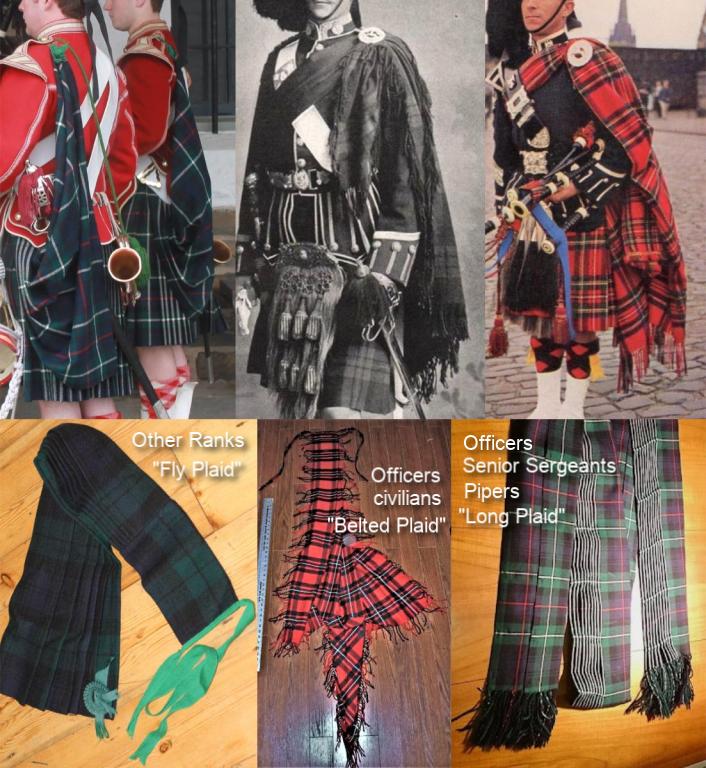
Ah, that opens a can of worms, because "fly plaid" is loosely used to cover three quite different garments.
1) The thing called the belted plaid in all the old catalogues. This was introduced for army officers c1800 when the breacan-an-feileadh was abolished. By the late 19th/early 20th century it had become stantard in civilian Evening Dress as well. (As with some other items of Highland Dress it's unclear whether it had a military or civilian origin.)
The belted plaid is an elaborate tailored garment, essentially a big square of tartan, purled fringe on three sides, the fourth side pleated and 'let' into a matching tartan self-belt that goes round the waist under the vest, hence the name.
On the purled side opposite the side attached to the belt, in the centre, is a triangular piece of matching tartan, one side pleated and attached to the plaid, the other two sides having purled fringe. This fringed tab is passed through the left epaulette and a Plaid Brooch is pinned just below the epaulette.
2) The thing called the fly plaid in the military. This is a purely military garment, introduced for Other Ranks c1800 as a simpler, less expensive alternative to the Belted Plaid. It has a tape belt tied round the waist and ribbons at one of the top corners which are tied to the left epaulette. It is not fringed.
3) The thing called a fly plaid in modern civilian dress, introduced for Kilt Hire c1990 as an even less expensive alternative to the plaids above. It's simply a square of tartan which is pinned at the left shoulder with a Plaid Brooch and just hangs down in the back without any sort of belt.
I've often seen it disparagingly referred to as a nappie.
The nappie and the "Laird's Plaid" aside, here are the three traditional forms of plaid.
Originally Posted by carlb
I assume that the dirk would be worn using frogs, suspended from my usual kilt belt.
Right. Actually there's never been such a thing as a "kilt belt" because kilts aren't held up by belts like trousers are.
The dirk is suspended by the thing called a "dirk belt" in the old catalogues, worn to support the dirk, and not otherwise.
The thing of trying to hold up an ill-fitting kilt with a Dirk Belt under the Vest is purely modern.
(My use of "vest" is intentional as that would have been the word used in the period you're doing. My pre-WWI publications use vest, while my Interwar publications often use vest and waistcoat interchangeably, even in the same paragraph, though some stick with vest and some use waistcoat. I'm not sure when "vest" underwent a Semantic Shift in Britain.)
Around 1930, a new sort of Evening Dress jacket was invented, the Montrose Shell Jacket. (A "shell jacket" ends at the waist all around, and was an extremely popular military style in Victorian times.)
The Montrose was introduced with a dedicated waistbelt, narrower than the traditional Dirk Belt.
Ironically the Montrose appeared after the wearing of dirks, belts, etc had fallen from favour...so one could say that the Montrose was introduced with its own dirkless dirk belt.
Originally Posted by carlb
Since the gentlemen mentions that hose, "are now knitted and can be obtained in any pattern," could diced hose be considered appropriate?
Exactly so, diced and tartan hose have always been considered equally appropriate for Evening.
Originally Posted by carlb
Again, many thanks! I've got a lot more to work with than I did when I started thinking about this. 
You're welcome!!
It's awesome to see somebody take dressing to period seriously.
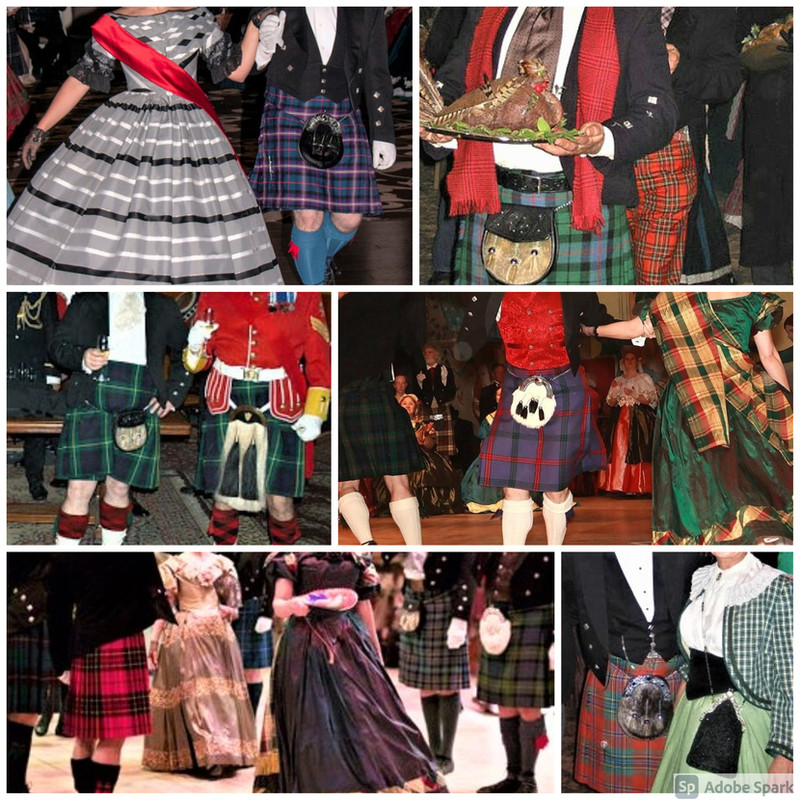
One of my soapbox issues is men showing up at Dickens Balls, Victorian Balls, Civil War Balls, etc wearing purely 20th century Highland outfits, as if Highland Dress floats outside of time itself.
Last edited by OC Richard; 16th December 25 at 09:13 PM.
Proud Mountaineer from the Highlands of West Virginia; son of the Revolution and Civil War; first Europeans on the Guyandotte
-
-
17th December 25, 04:58 AM
#14
Originally Posted by OC Richard
...The (dirk) belt is fastened around the waist under the vest.[/I] (The term "waistcoat" was in the future.)
Hmmm... Not sure about this, Richard.
The term 'waistcoat' has been used in English since the early 1500s, but 'vest' seems to be what Charles II called it when he set the sartorial standard at Court in the 1660s, according to Samuel Pepys - a French term no doubt as a result of the King's long sojourn in France during the Commonwealth.
Curiously, to the French, a vest (veste or veston) is the short, universal suit-type jacket, while gilet is the term for waistcoat. In the UK, 'vest' is used almost exclusively by tailors, probably due to the historical fashion associations, and lesser mortals use 'waistcoat but say it as 'weskit' which is how it is sometime written.
If a man were to appear in public in 'vest and pants' here in the UK, he would be marched off quickly to the local nick for a public order offence, as that is what we call underwear! I have seen sporting tweed breeks referred to as 'knickers' (from knickerbocker) by unsuspecting holiday-makers, which has been met with mirthful childish sniggering. Knickers are usually skimpy little lace numbers that ladies like to keep hidden under their clothes.
There is some evidence in historical writings (mainly by European observers) that the Highland style up to the 18th century was for men to wear two waistcoats together, with the inner one being slightly longer. I take these to be more a form of sleeveless doublet, rather than like our modern suit-style under-jacket waistcoat (or vest) - so pipebands who perform in waistcoat and no jacket are committing a sartorial crime whilst being arguably historically correct.
-
-
17th December 25, 11:38 AM
#15
The English language is fairly universal in many parts of the world, it's the use of the slightly less common words that causes the mayhem when used in a descriptive way that causes the misunderstandings worldwide. Whilst many know and understand the various general terminologies used worldwide, it can and does cause somewhat of a shock to many when the chaos of understanding and misunderstanding occurs when used internationally and at home! This website is a perfect example. It would help no end, if more of us understand that Worldwide. When added to British understatement and the use of local terminology using the same words but with different meanings, then chaos is almost guaranteed! 
Last edited by Jock Scot; 17th December 25 at 12:24 PM.
" Rules are for the guidance of wise men and the adherence of idle minds and minor tyrants". Field Marshal Lord Slim.
-
-
17th December 25, 11:47 AM
#16
Originally Posted by Troglodyte
The term 'waistcoat' has been used in English since the early 1500s, but 'vest' seems to be what Charles II called it when he set the sartorial standard at Court in the 1660s, according to Samuel Pepys - a French term no doubt as a result of the King's long sojourn in France during the Commonwealth.
About the 1500's I'll take your word for it.
All I know is that my various books and catalogues printed in Scotland prior to World War One use "vest", while the ones printed between 1926 and 1938 sometimes use "vest" and "waistcoat" interchangeably, while others only use one word or the other.
There's an adage in linguistics that a language won't have two words which mean precisely the same thing, because when a language does find itself in that position one of the two eventually undergoes a semantic shift or falls out of use.
Thus English found itself with two words that meant the same thing, borrowed Norse "sky" and native English "heaven" until the latter underwent semantic shift and began referring to a particular region in the sky. Ditto English "shirt" and Norse "skirt" which had to get out of each other's way, and moved above and below the waist.
So having "waistcoat" and "vest" meaning the same thing it's to be expected that one would undergo semantic shift, or one would disappear from the language. The former happened in Britain, but I don't know when.
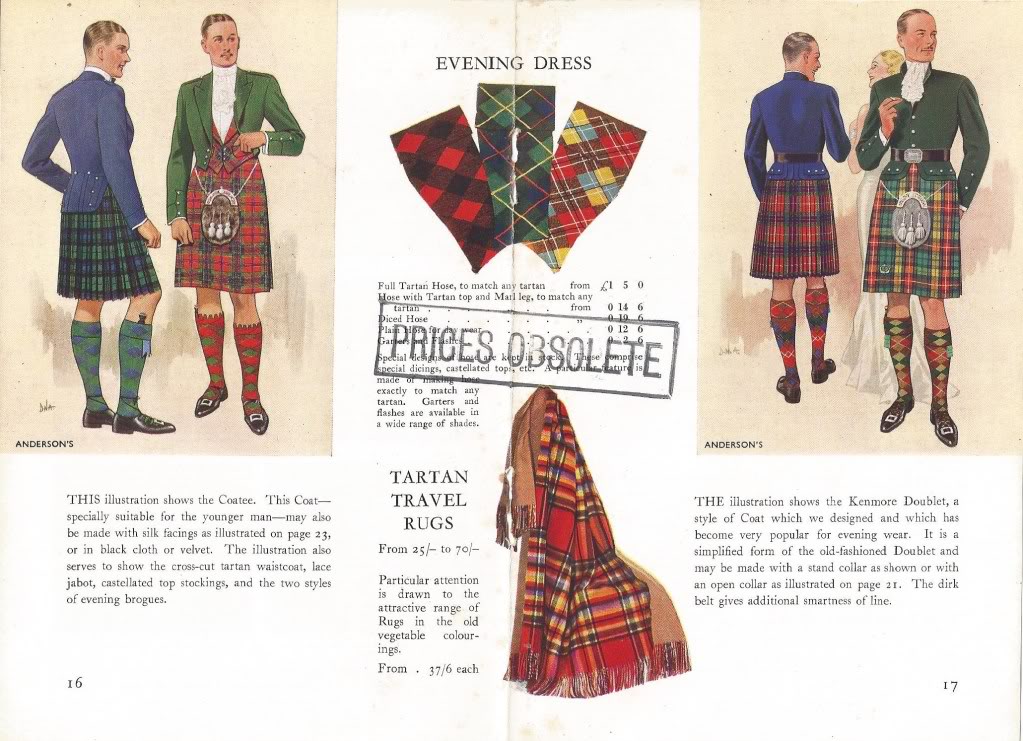
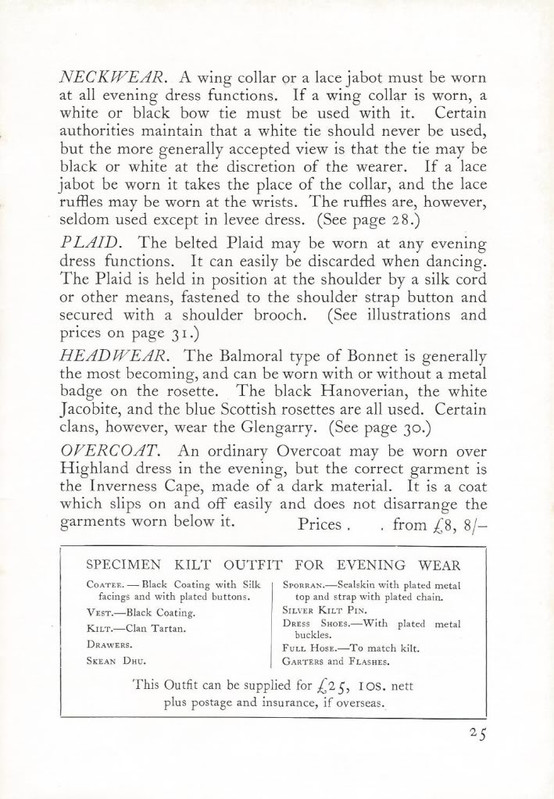
Here's two pages from the same catalogue from 1936 showing "waistcoat" and "vest" both used to refer to the waistcoat/vest of the same style of Evening Dress jacket, the Coatee. This suggests that the semantic split between the two words hadn't yet taken place.
Moving earlier to 1909 "vest" is used in the description of all five Highland outfits (these three and two Youth's outfits).
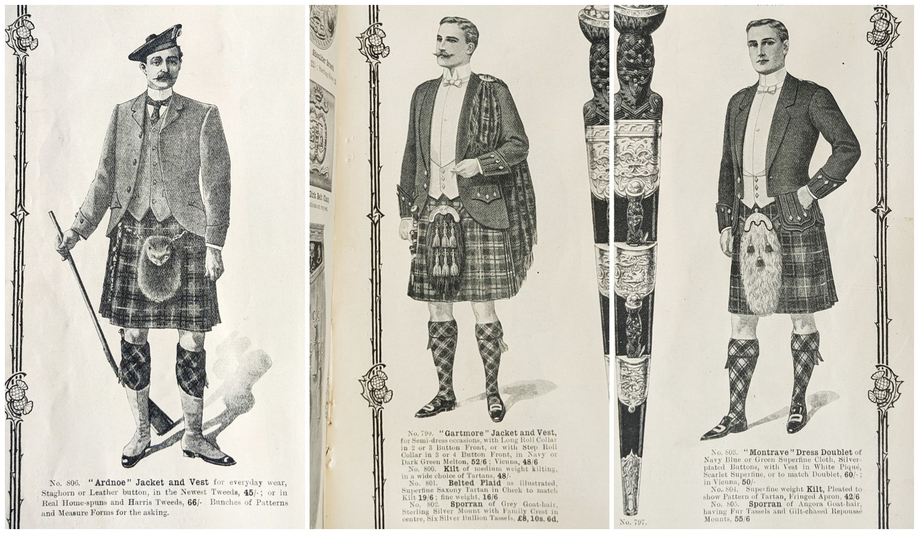
Trying to quickly trace the vest v. waistcoat thing with my not-great library, I see:
John Telfer Dunbar (1962) "waistcoat"
HF McClintock (1950) "waistcoat"
MacQueen Douglas FRSE FSA Scot. (1914) "vest"
DW Stewart (1893) "vest"
John Allen (AKA Sobieski Stewart) (1842) "waistcoat"
Last edited by OC Richard; 17th December 25 at 12:41 PM.
Proud Mountaineer from the Highlands of West Virginia; son of the Revolution and Civil War; first Europeans on the Guyandotte
-
 Posting Permissions
- You may not post new threads
- You may not post replies
- You may not post attachments
- You may not edit your posts
-
Forum Rules
|
|










 Reply With Quote






Bookmarks