|
-
-
The Following User Says 'Aye' to OC Richard For This Useful Post:
-
Campaign Medals
Richard,
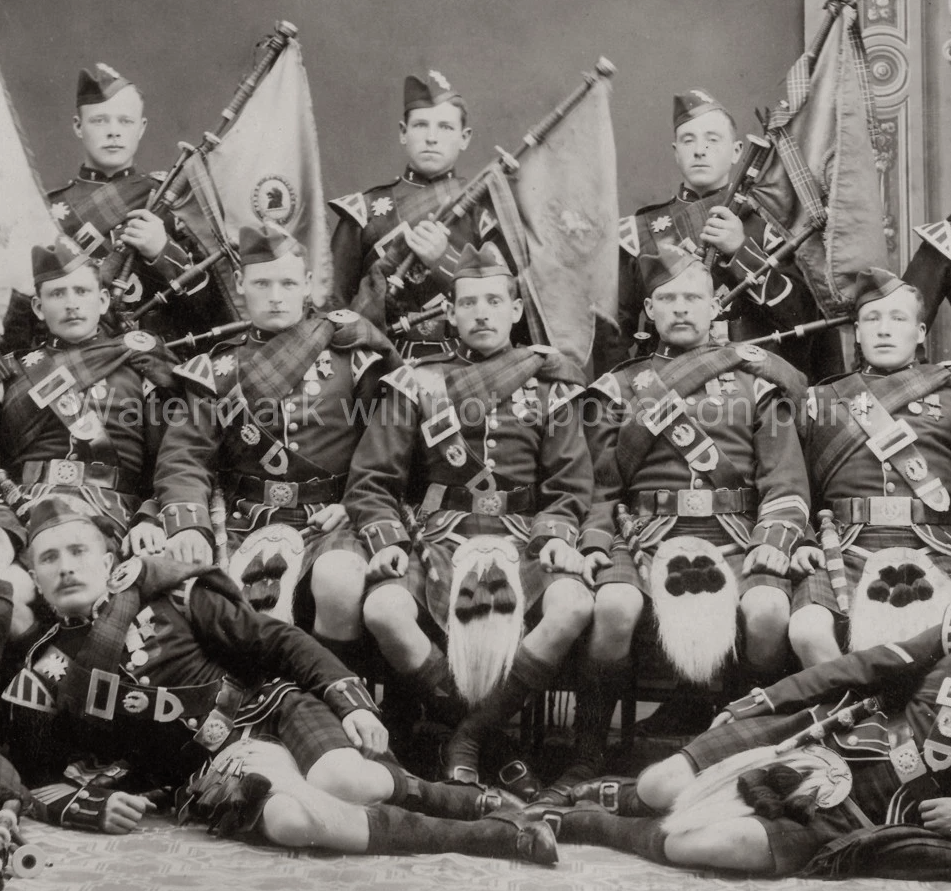
I can’t speak to the uniforms, but based on the campaign medals, I’d say the photo was taken sometime after 1882. The star shaped medal looks to me like the Khedives Star, awarded from 1882 to 1891, and always accompanies the Egypt Campaign Medal (the round medal). This makes sense since the 1st BN Black Watch was in Egypt from 1882 to 1886.
-
-
Fantastic, thank you for sharing!
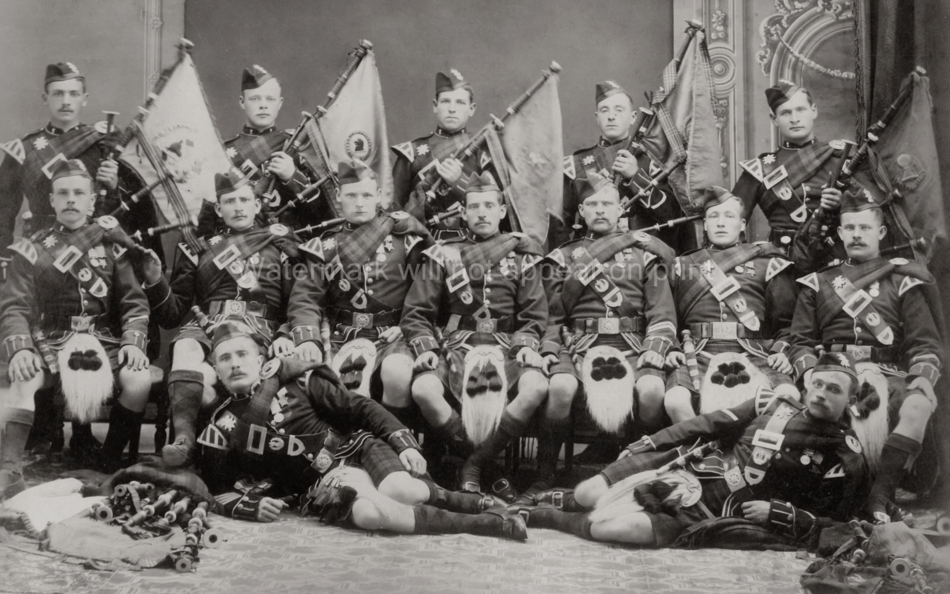
I wonder why the two gentlemen in the front are laying down. There are 7 in the middle row, and if those two moved to the back, there would be 7 in the back row. I guess they wanted the extra space to display those banners.
Is there a significance to them being in the front, or is it just for general composition?
-
-
 Originally Posted by OC Richard

Of course we have the famous "Crimean veterans" series of photos one of which shows Pipe Major David Muir of the Black Watch wearing a Black Watch tartan doublet and Black Watch band/music tartan kilt and plaid.
And there's a colour illustration of around the same period showing this.
Later Victorian images of Black Watch pipers show them wearing Royal Stewart kilts and plaids.
When did this change happen? I had thought possibly 1860. Why? I suppose because that was when all Highland regimental pipers were put into green doublets, though there's no reason both changes should go together.
That is roughly the date I believe that the change happened.
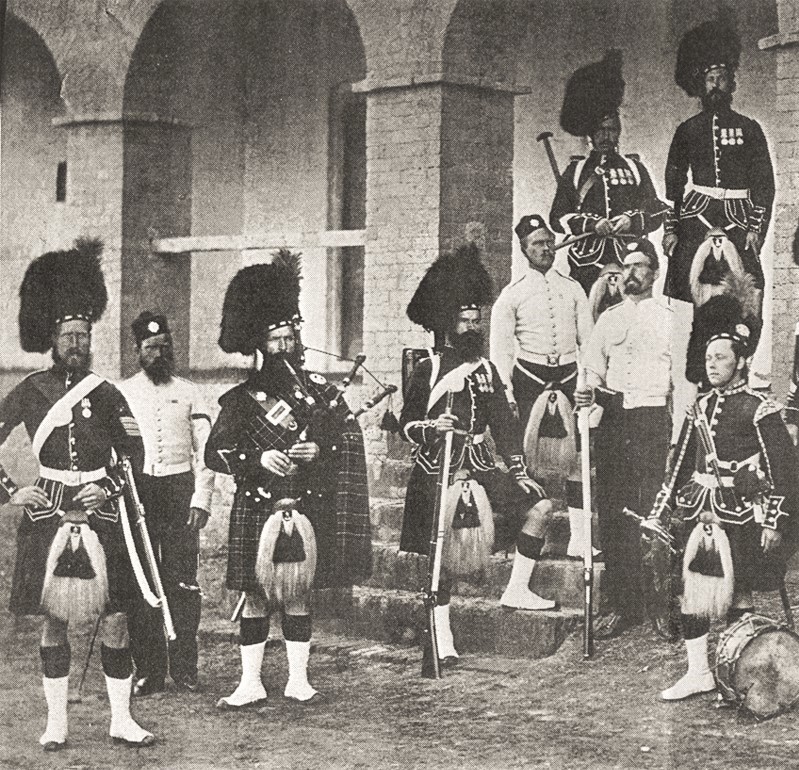
Here are members of the Black Watch in India, said to be 1865, the piper seemingly wearing Royal Stewart.
Correct, it is Royal Stewart.
I was surprised today to see the photo below showing Black Watch pipers, in the style of doublet adopted in 1868, appearing to wear the band or musicians' tartan (or Black Watch tartan which is less likely).
This pushes the change to Royal Stewart later than I had imagined.
Compare the tartan worn by the pipers and the soldiers. Tonally that are the same across all three colours and I feel sure that they, the pipers, are wear the standard 42nd rather than the Music tartan. Why they are not wearing RS I cannot sau.
-
-
Originally Posted by ivanovic
Richard,
Based on the campaign medals, I’d say the photo was taken sometime after 1882. The star shaped medal looks to me like the Khedives Star, awarded from 1882 to 1891, and always accompanies the Egypt Campaign Medal (the round medal). This makes sense since the 1st BN Black Watch was in Egypt from 1882 to 1886.
Thanks! That introduces another angle: whether this is the 2nd Battalion Black Watch, which until the Childers reforms of 1881 was the 73rd (Highland) Regiment of Foot.
What I can't find out is whether or not the 73rd Foot, which lost their Highland status in 1809 but had their "Highland" title restored in 1845, had pipers. (I've also seen the date given as 1862.)
If so they probably would have worn Black Watch kilts and plaids, that being the tartan worn by the 73rd from their raising in 1780 till their loss of Highland status in 1809.
We sometimes see photos showing hybrid pipers' uniforms in period immediately following the 1881 amalgamations, as the non-kilted battalion transitioned to the kit of the kilted battalion. Perhaps this is what we're seeing here.
(BTW unlike some of the other 1809 de-kilted regiments which later acquired tartan trews, the rank-and-file of the 73rd appeared to wear ordinary black trousers. I did see one painting which shows an officer wearing tartan trews, but numerous photos show officers wearing plain dark trousers.)
Last edited by OC Richard; Today at 04:59 AM.
Proud Mountaineer from the Highlands of West Virginia; son of the Revolution and Civil War; first Europeans on the Guyandotte
-
-
Originally Posted by User
I wonder why the two gentlemen in the front are laying down. Is there a significance to them being in the front, or is it just for general composition?
I guess they wanted the extra space to display those banners.
I think you're right, they wanted to show off the pipe banners.
Identifying the emblems on the banners would probably solve the question of which battalion of the Black Watch this is.
One of the men reclining in front is the Pipe Major, which is an interesting choice by him.
In photos of Pipe Corps the Pipe Major is generally at far left, which from the soldiers' perspective is far right, the Pipe Major's position on the march. (When the Pipe Major is giving commands to the band he prefaces them with "By the Right..." as in "By the Right, Quick March!")
Proud Mountaineer from the Highlands of West Virginia; son of the Revolution and Civil War; first Europeans on the Guyandotte
-
 Posting Permissions
- You may not post new threads
- You may not post replies
- You may not post attachments
- You may not edit your posts
-
Forum Rules
|
|








 Reply With Quote






Bookmarks