|
-
 Originally Posted by jsrnephdoc

You've taught me something there. I just assumed (OBVIOUSLY incorrectly) that pleating to the stripe needed to be pleating to the pivot point stripe, which obviously is NOT the case.
You can pleat to anything that repeats often enough to not have the pleats suck up too much cloth.
Well, not really. Because you have to take the visible width of the pleats on the stitched portion into account.
You can pleat to any band that's wide enough to occupy an entire pleat-width.
Or you can pleat to any narrow stripe/line that's bordered by wide-enough same-colour stripes on both sides.
So Robertson Hunting you can pleat to the narrow red line or white line because each is embedded in a wide band of the same colour.
You can pleat to solid blue bands or solid green bands IF the bands are wide enough and the pleats narrow enough.
Last edited by OC Richard; Yesterday at 05:37 AM.
Proud Mountaineer from the Highlands of West Virginia; son of the Revolution and Civil War; first Europeans on the Guyandotte
-
-
About the pivot, weavers can correct me but at least with computer tartan-generators it's arbitrary what point in a tartan you choose to start the count from, due to (most) tartans being bilaterally symmetrical.
You just have to be aware of what reckoning method for the pivot is being used.
As Peter MacDonald states in his edition of the 1819 Key Pattern Book:
"It is important to understand that Wilsons followed the standard tartan weaving practice of measuring their thread counts from the middle of the pivot...therefore in order to reproduce a normal symmetrical pattern the pivot counts (the first and last number) have to be doubled.
This does not apply to an asymmetric count such as Hunting Stewart."
Whereas with the computer tartan generators I've used if you put in the half-pivot number the stripe will come out half the size it needs to be.
Proud Mountaineer from the Highlands of West Virginia; son of the Revolution and Civil War; first Europeans on the Guyandotte
-
-
Originally Posted by OC Richard
About the pivot, weavers can correct me but at least with computer tartan-generators it's arbitrary what point in a tartan you choose to start the count from, due to (most) tartans being bilaterally symmetrical.
Richard,
AFAIK, they all require one to start and finish on the pivot (of a symmetrical sett) in order to allow the correct repeat to be generated.
-
-
Originally Posted by OC Richard
You can pleat to anything that repeats often enough to not have the pleats suck up too much cloth.
Well, not really. Because you have to take the visible width of the pleats on the stitched portion into account.
You can pleat to any band that's wide enough to occupy an entire pleat-width.
Or you can pleat to any narrow stripe/line that's bordered by wide-enough same-colour stripes on both sides.
So Robertson Hunting you can pleat to the narrow red line or white line because each is embedded in a wide band of the same colour.
You can pleat to solid blue bands or solid green bands IF the bands are wide enough and the pleats narrow enough.
Also, if you have two bands that are too narrow to fully occupy a pleat, you can use the center of the transition of those bands to pleat the kilt to. E.G. you could pleat OC Richard's example tartan by making each pleat light green on the left half and dark green on the right.
-
The Following User Says 'Aye' to User For This Useful Post:
-
Originally Posted by figheadair
Richard,
AFAIK, they all require one to start and finish on the pivot (of a symmetrical sett) in order to allow the correct repeat to be generated.
Right you are, I just now went on the "St Kilda Kilts" (formerly Gaelic Web) tartan generator:
https://stkildastore.com/store/tarta...igner/designer
I made up a simple tartan and started from two different points to see if it would generate the same thing.
It did, as you say I had to start and finish with a duplicated complete pivot stripe for it to complete the turnaround.
Proud Mountaineer from the Highlands of West Virginia; son of the Revolution and Civil War; first Europeans on the Guyandotte
-
-
Originally Posted by User
Also, if you have two bands that are too narrow to fully occupy a pleat, you can use the center of the transition of those bands to pleat the kilt to. E.G. you could pleat OC Richard's example tartan by making each pleat light green on the left half and dark green on the right.
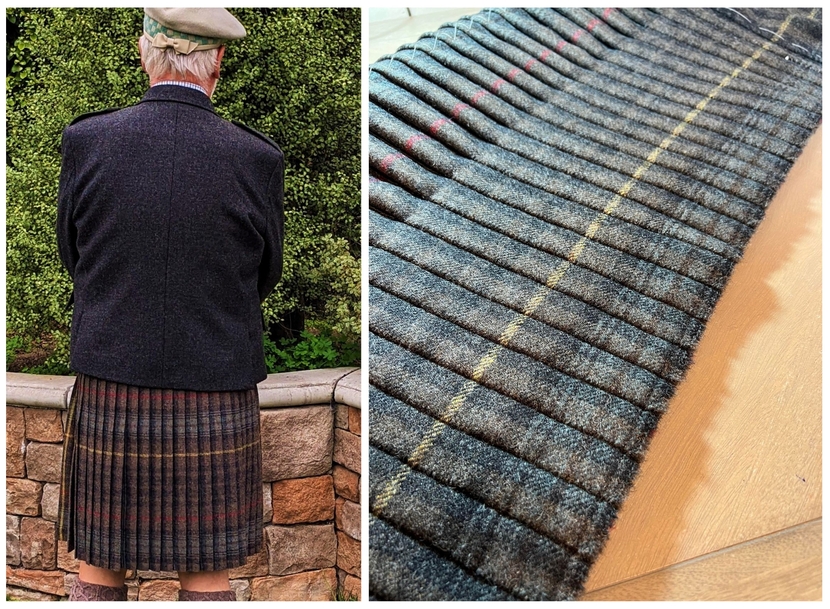
Cathy Hope did that (or something like it) with my Hunting Stewart kilt.
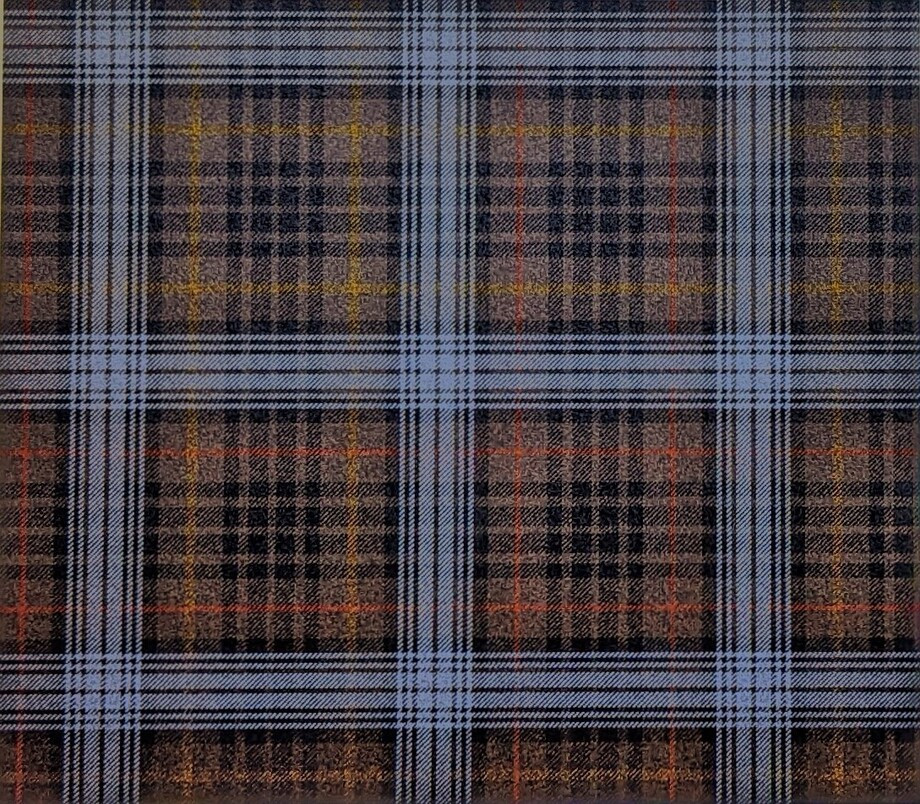
It's a non-repeating AKA asymmetrical tartan and notoriously tricky to pleat. The underlying tartan has a normal repeating structure but the red and yellow overcheck doesn't.
The army pleats it with alternating yellow and red lines.
Cathy came up with this clever way to have all the pleats look the same.
(What's interesting is that hidden inside the pleats are the alternating yellow and red lines of the military pleating.)
Why on earth don't they make the overcheck lines symmetrical? It would save everybody a lot of trouble.
Last edited by OC Richard; Yesterday at 07:57 AM.
Proud Mountaineer from the Highlands of West Virginia; son of the Revolution and Civil War; first Europeans on the Guyandotte
-
The Following User Says 'Aye' to OC Richard For This Useful Post:
-
 Making your own kilt - so many questions Making your own kilt - so many questions
Originally Posted by OC Richard
You can pleat to any band that's wide enough to occupy an entire pleat-width.
Or you can pleat to any narrow stripe/line that's bordered by wide-enough same-colour stripes on both sides.
So Robertson Hunting you can pleat to the narrow red line or white line because each is embedded in a wide band of the same colour.
But, pleating to the white stripe probably wouldn't "pop" as much as one might like because of the large sett size?
Not precisely on point, but in terms of learning HOW one makes a kilt I found two sources of new answers and new questions yesterday.
First, in an email exchange with Barb Tewksbury, I learned that she still does an annual 1 week long mid-spring kilting academy in Upstate NY where a student may come in with little prior experience but enough cloth to emerge 1 week later with a handsewn kilt.
Second, I watched a new example of one of Rocky's USA Kilts YouTube videos, where he interviewed principals from House of Edgar AND Lochcarron side by side. I came away from that with new questions, but entertained by the exchanges. For example:
- Is it really economically desirable as well as a selling point that Lochcarron weaves its 16 oz fabric from sheep that munch grass "in the neighborhood" rather than in Australia or New Zealand? (I don't think the Strait of Hormuz gets in the way of THAT shipping). Corollary: can one make a decent income raising sheep in the Scottish Borders?
- What is "finishing" of cloth that's come off the loom, and does it vary from weaver to weaver?
- Why would a customer care whether the cloth used to make his or her kilt was woven on a single-width vs. a double-width loom? Does that have something to do with the fabric edge (selvedge)?
In the comments a few people commented about how BOTH of the Scots were attired in almost identical slacks and pullovers, while Rocky was the only one kilted. Both interviewees indicated it was a good time to be in the tartan production business, which begs the question of what happened to DC Dalgliesh.
-
-
Originally Posted by OC Richard
About the pivot, weavers can correct me but at least with computer tartan-generators it's arbitrary what point in a tartan you choose to start the count from, due to (most) tartans being bilaterally symmetrical.
You just have to be aware of what reckoning method for the pivot is being used.
As Peter MacDonald states in his edition of the 1819 Key Pattern Book:
"It is important to understand that Wilsons followed the standard tartan weaving practice of measuring their thread counts from the middle of the pivot...therefore in order to reproduce a normal symmetrical pattern the pivot counts (the first and last number) have to be doubled.
This does not apply to an asymmetric count such as Hunting Stewart."
Whereas with the computer tartan generators I've used if you put in the half-pivot number the stripe will come out half the size it needs to be.
It's becoming more and more obvious to me that I need to learn to trust the wisdom of the kilt maker, but I'll still ask another question:
Is it perfectly acceptable, when pleating to the sett, to have both ends of the pleated portion symmetrical but NOT continuing the sett's vertical pattern during the transition from back pleated portion to aprons.
For example, in my Robertson Ancient Hunting kilt, the vertical orange stripe repeats at 1/2 the sett size at both lateral ends of the pleated portion (exactly the converse of the white vertical pivot stripe being buried in the center pleat).
Oh, one more: what's a definition for "overcheck" that would be understandable to a newbie.
And, perhaps, yet another: how difficult would it be for a kilt-production house to offer tartan-design software output printouts to display to a potential kilt customer what those transitions from pleated to non-pleated portions of the garment (or, for that matter, how they would envision the garment would look at those transitions when pleated to the sett or stripe or box-pleated. My totally ignorant guess is that the software probably couldn't do that.
Thanks so much!
-
-
Originally Posted by OC Richard
Cathy Hope did that (or something like it) with my Hunting Stewart kilt.
It's a non-repeating AKA asymmetrical tartan and notoriously tricky to pleat. The underlying tartan has a normal repeating structure but the red and yellow overcheck doesn't.
The army pleats it with alternating yellow and red lines.
Cathy came up with this clever way to have all the pleats look the same.
(What's interesting is that hidden inside the pleats are the alternating yellow and red lines of the military pleating.)
Why on earth don't they make the overcheck lines symmetrical? It would save everybody a lot of trouble.
Oh, that is lovely!
-
-
Originally Posted by jsrnephdoc
...
Is it really economically desirable as well as a selling point that Lochcarron weaves its 16 oz fabric from sheep that munch grass "in the neighborhood" rather than in Australia or New Zealand?
...
It's certainly a selling point for me. It's the reason I purchased my tartan cloth from Lochcarron, and will continue to select Lochcarron wool every time I have the choice.
Originally Posted by jsrnephdoc
...
Why would a customer care whether the cloth used to make his or her kilt was woven on a single-width vs. a double-width loom? Does that have something to do with the fabric edge (selvedge)?
...
For the customer, double width just means there will be a join hidden in a middle pleat. Not a big deal at all. For the kilt maker, there's no ideal way to join two halves of a double width asymmetrical tartan. For this reason, it's typical for asymmetrical tartans to be woven in single width.
-
 Posting Permissions
- You may not post new threads
- You may not post replies
- You may not post attachments
- You may not edit your posts
-
Forum Rules
|
|







 Reply With Quote





Bookmarks