|
-
 There's a reason you won't find tartan fabric at K-mart There's a reason you won't find tartan fabric at K-mart
 Originally Posted by User

For the customer, double width just means there will be a join hidden in a middle pleat. Not a big deal at all. For the kilt maker, there's no ideal way to join two halves of a double width asymmetrical tartan. For this reason, it's typical for asymmetrical tartans to be woven in single width.
Exposes how little I know (and how little I STILL understand): doesn't double width just mean a "canvas" of the same pattern, twice as wide? In other words, why would a piece of fabric twice as wide have to be sewn together, whereas one half that width would not?
Another question: why is single width fabric MORE expensive? My previous guess (based on no INFORMATION whatsoever) was that single width looms were more "historical antiques" and required much more maintenance, but I do think I remember reading somewhere that they were more easily coaxed into creating fabric with herringbone selvedge at one extreme or the other.
(When USA Kilt's Rocky Roeger asked the managers of Lochcarron and House of Edgar one thing they each thought their house did "better" than the other, the HoE guy answered immediately "we do a whole LOT of single width cloth)."
-
-
Originally Posted by jsrnephdoc
Exposes how little I know (and how little I STILL understand): doesn't double width just mean a "canvas" of the same pattern, twice as wide? In other words, why would a piece of fabric twice as wide have to be sewn together, whereas one half that width would not?
...
Your understanding of double width is correct.
If I want to make one 8 yard kilt, I don't buy 8 yards of double width fabric, because I'll have too much. Instead I buy 4 yards of double width, rip it in half, and join the halves. That's where the seam comes from, but you hide it in a pleat.
If I'm making two 8 yard kilts from the same tartan, then I can buy 8 yards of double width, rip it in half, and use each half to make a kilt without the need to join them.
I could only venture guesses at your other question.
-
-
Originally Posted by User
I buy 4 yards of double width, rip it in half...
This ripping, by the way, is terrifying to watch.
Proud Mountaineer from the Highlands of West Virginia; son of the Revolution and Civil War; first Europeans on the Guyandotte
-
The Following User Says 'Aye' to OC Richard For This Useful Post:
-
Originally Posted by jsrnephdoc
I learned that Barb Tewksbury still does an annual 1 week long mid-spring kilting academy in Upstate NY where a student may come in with little prior experience but enough cloth to emerge 1 week later with a handsewn kilt.
I highly recommend that you attend that if you possibly can.
I attended just such a class given by her Art Of Kilt Making co-author Elsie Scott-Stuehmeyer.
It was amazing. You'll learn more about kilts from a week of hands-on doing than you could from any amount of talking about them. Suddenly everything unclear and mysterious will be understood.
Last edited by OC Richard; Yesterday at 10:52 AM.
Proud Mountaineer from the Highlands of West Virginia; son of the Revolution and Civil War; first Europeans on the Guyandotte
-
-
Originally Posted by jsrnephdoc
But, pleating to the white stripe probably wouldn't "pop" as much as one might like because of the large sett size?
You wouldn't pleat to the white lines because they're too far apart (12 inches).
If you wanted the white line to appear on every pleat, and you wanted the kilt to have the normal number and width of pleats, you'd have twice as much cloth used up in the rear of the kilt, which would be really heavy.
You'd want to either alternate white and red lines, or chose a single feature that occurs every 6 inches (red line, blue block, green block, black block).
Proud Mountaineer from the Highlands of West Virginia; son of the Revolution and Civil War; first Europeans on the Guyandotte
-
-
Another "oops" on my part
Originally Posted by OC Richard
You wouldn't pleat to the white lines because they're too far apart (12 inches).
If you wanted the white line to appear on every pleat, and you wanted the kilt to have the normal number and width of pleats, you'd have twice as much cloth used up in the rear of the kilt, which would be really heavy.
You'd want to either alternate white and red lines, or chose a single feature that occurs every 6 inches (red line, blue block, green block, black block).
I was envisioning the white stripe being prominent HORIZONTALLY. It does "happen" on my kilt, because it's pleated to the sett, but it doesn't in any way stand out different from the front.
-
-
Originally Posted by OC Richard
I highly recommend that you attend that if you possibly can.
I attended just such a class given by her Art Of Kilt Making co-author Elsie Scott-Stuehmeyer.
It was amazing. You'll learn more about kilts from a week of hands-on doing than you could from any amount of talking about them. Suddenly everything unclear and mysterious will be understood.
I had no idea while I was accumululating my first few kilts that she lived just a few miles away from me in Petaluma. I think she's no longer with us, sadly.
-
-
Originally Posted by jsrnephdoc
I was envisioning the white stripe being prominent HORIZONTALLY.
That's the argument sometimes raised against "pleating to the block": with no vertical elements showing on the pleats, the horizontal elements take over.
I believe in The Art Of Kiltmaking it's called "the dreaded lawn-chair effect."
That happened a bit with my Hunting Stewart (weathered) kilt due to that tartan having those really far-apart yellow and red lines (sort of like an over-check). It was made worse by a decision by the weavers, which I feel is a poor and inexplicable decision, to make those red and yellow lines extra fat, exaggerating the very thing that throws off the symmetry of the tartan.
Proud Mountaineer from the Highlands of West Virginia; son of the Revolution and Civil War; first Europeans on the Guyandotte
-
-
 Using the right tools for a job (assuming you can still pick up the tool) Using the right tools for a job (assuming you can still pick up the tool)
Originally Posted by OC Richard
That's the argument sometimes raised against "pleating to the block": with no vertical elements showing on the pleats, the horizontal elements take over.
I believe in The Art Of Kiltmaking it's called "the dreaded lawn-chair effect."
Another reason I wonder whether tartan DESIGN software could be used to map possible pleating schemes.
The alternative is, of course, extreme dedication on the part of the kilt maker.
When Barb Tewksbury sewed my "Lunar" tartan kilt she sent me photos illustrating 3 different pleating options: 2 to different stripes, and one to the sett, all based on non-destructive pinning of the fabric.
Not that I would envision ever USING the tartan design software for that purpose (especially given that I'd not even attempt to do so for its REAL purpose—designing a tartan of my own. Hell, at my age I consider it a major accomplishment if I can manage "sleeping to the set" alarm clock!
-
-
Originally Posted by jsrnephdoc
I wonder whether tartan DESIGN software could be used to map possible pleating schemes.
About that I don't know, but with an online collage maker it's easy to string together a series of narrow images that imitates what the pleats would look like, pleated to the black block, pleated to the pairs of black lines (which probably won't work), pleated to the red line.
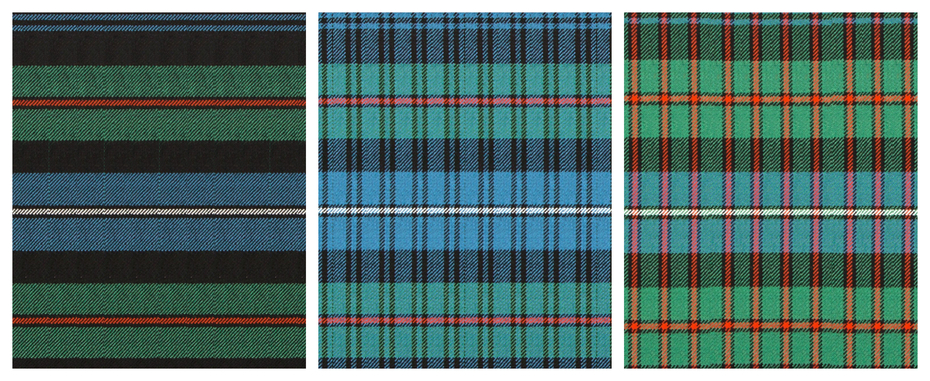
The best way is for the kiltmaker to have the cloth so they can send you photos of mockups of the various pleating options.
That's what happened with my Cathy Hope kilts.
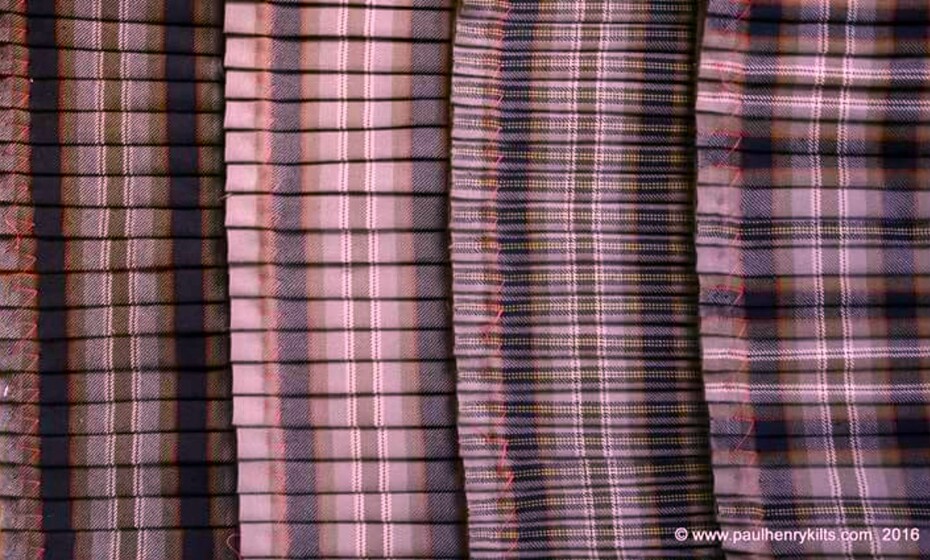
Here are various pleating concepts proposed by kiltmaker Paul Henry for the Scottish Wildcat tartan.
It's amazing how differently they all look. (Personally I'd go with the one at far left.)
Last edited by OC Richard; Today at 01:20 PM.
Proud Mountaineer from the Highlands of West Virginia; son of the Revolution and Civil War; first Europeans on the Guyandotte
-
 Posting Permissions
- You may not post new threads
- You may not post replies
- You may not post attachments
- You may not edit your posts
-
Forum Rules
|
|







 Reply With Quote





Bookmarks