|
-
 Originally Posted by jsrnephdoc

This photo nicely shows most aspects of traditional men's Evening Dress being followed, such as full tartan hose and Evening Dress sporrans.
Also seen are two cuts of Evening Dress jackets, the Prince Charlie coatee and the Evening Argyll, the latter having been co-opted by Pipe Bands and worn during the day.
Originally Posted by jsrnephdoc
Ghillie Brogues...a fanciful invention...tongueless shoes that laced up the legs to keep them on while permitting the feet to dry out afterwards.
To be clear, self-made deerskin moccasins that lace around the foot are historically documented.
What does appear to be a Victorian invention is the "Ghillie brogue", a built-up modern shoe with the top modified to superficially resemble the ancient shoe.
We could label the Ghillie brogue a "traditional" shoe if an unbroken chain of evolutionary forms could be documented establishing its descent from the ancient shoe...but alas! The Ghillie brogue appears to have been cooked up by the Allen Brothers as part of their personal costumes.
Originally Posted by jsrnephdoc
Where to wear a plaid in Scotland...
...or anywhere else. Sorry to say, but as early as the 1930s a gent would have looked out of style were he to arrive at an Evening do wearing plaid, dirk, etc. For whatever reason World War One put paid to nearly all the old Victorian accessories.
Originally Posted by jsrnephdoc
...the frequently-expressed convictions here that Ghillie Brogues are almost EVIL...
Certainly they are universally hated in the Pipe Band world due to most bands requiring them, and really comfortable ones being hard to find.
Also certainly they're not traditional (see above). The military, that bastion of tradition, never adopted them for any of their many forms of dress. (However some military pipe bands purchase and wear civilian outfits when competing at Highland Games including Ghillies.)
Personally I like the look of Ghillies for the simple reason that they're a shoe unique to Highland Dress, however untraditional they may be.
Originally Posted by jsrnephdoc
The anchor of "modern" highland ness (the knee length "little" kilt) seems also to have been an invention for military use rarely worn by civilians as an everyday garment.
Perhaps the little kilt had a military origin, perhaps not. As far as I know the jury is still out.
Sir John Sinclair wrote in 1804
"Whether the philibeg, or short petticoat, is an old part of the dress, or a modern alteration, is disputed.
Many contend that it was first substituted, on account of its lightness, for the belted plaid by Highland woodcutters employed by English companies in Argyllshire and Lochaber about the year 1730."
Last edited by OC Richard; Yesterday at 08:50 AM.
Proud Mountaineer from the Highlands of West Virginia; son of the Revolution and Civil War; first Europeans on the Guyandotte
-
-
Alright, I think the arisaid idea may be on the back burner. After a discussion with my dear wife on this subject , she agrees that the arisaid is really not the best idea, but on her suggestion. How about a nice modern skirt, of a length and style of her choice in the tartan that you have woven, for your wife?
Last edited by Jock Scot; Yesterday at 10:55 PM.
" Rules are for the guidance of wise men and the adherence of idle minds and minor tyrants". Field Marshal Lord Slim.
-
The Following 2 Users say 'Aye' to Jock Scot For This Useful Post:
-
Originally Posted by NHhighlander
...a modern arisaid...
When I re-read you post that term got my notice.
It's a good question: just what might a "modern arisaid" be?
As we saw above a visitor to the Western Isles in the early 18th century described it as already being a minority hanger-on from times past. One wonders whether an outsider would even be in a position to know such things.
Just now going through Old Irish and Highland Dress, and The History of Highland Dress, his description is the only one using the term 'arisaid'.
What are mentioned over and over are "plaids".
A visitor to Inverness around 1730 wrote
"The Plaid is the Undress of the Ladies, and to a genteel Woman, who adjusts it with a good Air, is a becoming veil.
It is made of Silk or fine Worsted, chequered with various lively colours, two Breadths wide and three Yards in Length; it is brought over the Head, and may hide or discover the Face according to the Wearer's Fancy or Occasion; it reaches the Waist behind; one Corner falls as low as the Ankle on one Side; and the other Part in Folds hands down from the opposite Arm."
Note here no mention of white, nor mention of a brooch, nor mention of the term 'arisaid'.
From what little evidence I can see, I get the impression that the women's plaid stopped being worn as a standalone garment around the mid-18th century, replaced by women wearing an ordinary dress with a plaid loosely draped around the body and over one arm.
This parallels men wearing jacket and trews with a plaid draped around the body and over one arm rather than the belted plaid as a single standalone garment.
Since the continuity of wearing the women's plaid (like the men's belted plaid) was broken, wearing one today isn't the continuance of a traditional garment but the revival of a historical one.
As I mentioned the Outlander costumer created a garment which has now been seen by millions of people, most of whom probably think it's a traditional form of Scottish attire.
I suppose that's what might be called a "modern arisaid".
Proud Mountaineer from the Highlands of West Virginia; son of the Revolution and Civil War; first Europeans on the Guyandotte
-
-
Originally Posted by NHhighlander
Certainly! The Peter E. MacDonald paper seems to be the best compendium of our state of knowledge that I have found so far, even after twisting some arms and getting the 2008 Cheape Rediscovering, which is even older. I did mention that resource right in my (ok, too lengthy) original post...
Hey, @ figheadair (I use your nick when in the forum even if others use your real name, except when quoting the author, that I credit in full, certainly a bit confusing, sorry), question for you: this matter of antique Scottish Highlands female dress, that would seem like a made-to-order theme/subject for Master's, even Doctoral dissertations. Do those exist? I have no idea how to search Scottish academia.
Apologies, I was away and looking at the OP on my phone.
You cited the NMS example. Unfortunately, the staff there are not experts in this area and don't understand what the have. This and similar items are not examples of an arisaid, they are domestic blankets. I am not aware of any proven historical example of what is popularly portrayed as an arisaid. Personally, I would avoid the subject entirely.
-
-
Originally Posted by OC Richard
About modern women's Highland Dress, when I started playing in Pipe Bands in the mid-1970s putting women into men's Highland Dress wasn't yet a thing.
Here's a Pipe Band from Scotland from that time, showing a female piper in a female skirt, hose, and shoes. (She is however wearing a men's necktie and Glengarry as we see.)
With the men notice that only a couple are wearing Ghillies, which hadn't yet become a Pipe Band thing.
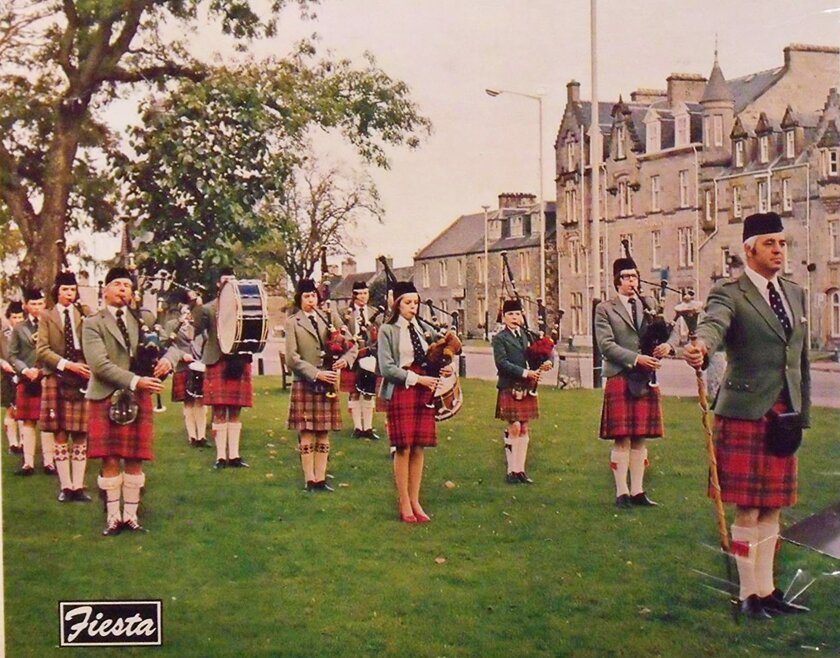
Interesting that TWO of the female pipers are in a different tartan from the others, that one of them is sporting a sgian dubh, and that two of them are wearing different hose-tops.
But I take your message overall as indicating a woman attending a clan gathering or other event in Scotland wearing an airisaid would find herself rather uniquely attired.
How about a man's kilt and kilt hose? My sense is that while some Scots consider a kilt rather routine daywear, it's far more likely worn for celebratory or occupational purposes, and that a woman would more likely be attired (depending on the formality of the event) in a calf-length (or longer) kilt skirt, perhaps accompanied by a sash worn atop a white silk blouse.
-
-
Ceremonial dress, for men AND women
Originally Posted by OC Richard
This photo nicely shows most aspects of traditional men's Evening Dress being followed, such as full tartan hose and Evening Dress sporrans.
Also seen are two cuts of Evening Dress jackets, the Prince Charlie coatee and the Evening Argyll, the latter having been co-opted by Pipe Bands and worn during the day.
Too bad my Dad's been gone for more than 3 decades. He would much have appreciated the compliment 
Unfortunately, high-res digital photos from which one could extract "secrets" by magnification were not yet around when someone (perhaps my mom, since she's not in the picture) snapped that photo. For example, it's not possible for me to determine whether the Chieftain is in "Robertson Red (white line), or not. But I DO think both he AND my dad are sporting kilt belts with big buckles, and the Chieftain doing so even while in a waistcoat!
But then, sartorial "oopses" colored both of their lives (and my mom's initial afterlife). Her favorite "uniform" as a high school English literature and Romance Languages teacher included Robertson Red kilt skirt and waistcoat, and when she died, my sister provided those to the undertaker for her "viewing." When we arrived at the funeral home my sister was the only one of us who noted that she was attired with the pleats IN FRONT!
Originally Posted by OC Richard
To be clear, self-made deerskin moccasins that lace around the foot are historically documented.
What does appear to be a Victorian invention is the "Ghillie brogue", a built-up modern shoe with the top modified to superficially resemble the ancient shoe.
We could label the Ghillie brogue a "traditional" shoe if an unbroken chain of evolutionary forms could be documented establishing its descent from the ancient shoe...but alas! The Ghillie brogue appears to have been cooked up by the Allen Brothers as part of their personal costumes.
and
Originally Posted by OC Richard
Personally I like the look of Ghillies for the simple reason that they're a shoe unique to Highland Dress, however untraditional they may be.
Of course, finding shoes that are comfortable is not a bridge too far, but a task to which some of us attach too little importance (try them on in a carpeted store while seated, then suffer later while trying to find my car in a distant parking lot at the end of a long day at highland games).
-
Tags for this Thread
 Posting Permissions
- You may not post new threads
- You may not post replies
- You may not post attachments
- You may not edit your posts
-
Forum Rules
|
|







 Reply With Quote






Bookmarks