|
-
22nd February 09, 07:02 PM
#31
As your question was answered before historic lowlanders did not wear the kilt. Now after saying that I can only guess at what you may be thinking so I will relate my own story. I was somewhat disapointed to begin tracing my Scottish heritage and the first name I looked up, Cordiner, has no clan affiliation. I thought growing up that scotland was the land of kilts and clans and after learning a little history all my boyhood fantasies seemed to go up in smoke.
Yet, once I began doing furhter family research I found that the lowlands are just as rich in culture and history as the highlands, my own family having come from the Peterhead area and a rich fishing history.
A few more generations down the line and names with gealic origins popped up.
I guess what I am getting at is a little research and a little patience and you may just find some highlanders in your tree. Although we like to speak about these seemingly long dead historical divisions between highlanders and lowlanders, there has also been alot of mingling between the two, especially in the 250 years since culloden.
The kilt at one time may have been the symbol of the Highlander, but today-at least here in the US, its a uiversal symbol for Scottishness.
-
-
22nd February 09, 08:34 PM
#32
I hope this isn't too long a reply...
 Originally Posted by Malcolm MacWilliam

So, help me out with the knowledge you folks have. Cause, since I have been doing the 18th century Highlander for 15 years (Jacobite, F and I and Rev Wars) we get the questions all the time. I continually try to make sure my lads and I are giving the correct info. Please correct or modify the info I have below so I can get a better timeline of "kilt history".
1. Kilts first appear in the 1400s, I believe "they" trace it to that time period because there is a gravestone someplace that shows a Highlander in a kilt.... this supposedly the earliest indication of kilt wearing? Any good research before that. AND, before that it was all English clothing??
Although the use of a simple length of material as a garment is as old as the hills, reliable sources indicate that the Highland Scots most likely wore the "leine croich", a long, pleated, coat-like affair that hung to past the knees. This is very similar to the garment worn under chain mail at the time of William the Conqueror and so may be assumed to be the common garb of men in Ireland and Scotland in the 11th century. From tomb effigies and drawings in early manuscripts it would appear that this form of dress, or something very much like it, was probably worn through the end of the 16th century, at which time (about 1600) the belted plaid (or great kilt) seems to have become commonly worn.
The great kilt was cumbersome and in short order the "little kilt", similar to that worn today, made its appearance. As far as I am aware the first accurate picture we have of the little kilt appears on what is known as "Gordon's Map of Aberdeen", dated 1661. This map shows a young man in a little kilt marking something with a compass. In 1672 the registers of the Lyon Court show a depiction of the arms of Skene, in which one of the supporters is clearly wearing a little kilt. David Morier's picture, "An Episode of the Rebellion", painted in 1746, shows a mob of Highlanders throwing themselves against the Hanoverian army-- but none can be described with any certainty as being clothed in great kilts.
Based on the graphic evidence of engravers, illustrators, and painters, I am led to believe that the great kilt lasted for a mere half century or so, before being slowly replaced by the more convenient small kilt in the second half of the seventeenth century.
Originally Posted by Malcolm MacWillam
2. So, kilts were worn and were the fashion in the Highlands (I had read anything north of the river Tay was Highland). Then, we have the '45. After Culloden, Kilts (Scottish dress) was outlawed....they quickly went out of fashion unless you could get awa' with it, so far north the English didn't care??
From 1746 until 1782 the wearing of tartan and of kilts was banned in Scotland, although the ban proved difficult to enforce. From many accounts, by the 1750's tartan, at least among the fashionable ladies of Edinburgh, was back in favour in Scotland. While the Act of Proscription was enacted in London, its execution fell largely to Scots who had little reason, and no real desire, to enforce the law. On the part of Parliament, once the Seven Years War had begun in 1756 they had far more important things to worry about than persecuting a few tartan clad Scots.
Originally Posted by Malcolm MacWilliam
3. However, if you joined the military (42nd, 78th, 77th, etc.) you could wear your "native dress", the kilt. This was done to entice young Scots to join the British army?
While much is made about the Black Watch et al "saving the tartan" its popularity in Scotland was also due, in no small part, to those aristocratic land owners who encouraged-- or at lest did nothing to discourage-- the wearing of "native garb" on their estates. Certainly no slacker when it came to promoting tartan on his estates was His Grace, the Duke of Atholl.
Such was Atholl's enthusiasm for all things tartan (and patriotism) that he raised a private regiment in 1778, drawn almost exclusively from the tenants on his land. In 1780, two years before the ban on tartan was lifted, David Allan painted a picture of the Duke and his family out shooting in the hills above Blailr Atholl. In the painting, the Duke, as well as the servant behind him, can clearly be seen wearing the little kilt.
Originally Posted by Malcolm MacWilliam
4. George IV and Sir Walter Scott make it vogue to wear the kilt, 1820s??
5. Sobieski brothers (cousins to the BP Charlie) do their hoax with "the book" of tartans and clans begin to register clan tartans....is this the time that Lord Lyon gets involved?
I think a lot of people underestimate the importance of the Sobieski-Stuart brothers in keeping the "Tartan Revival" alive. While their scholarship wobbled across the border between fact and fantasy, and while their own stated antecedents could probably best be described as a genealogical confection, at the peak of their popularity they provided the bridge between the "King's Jaunt" in 1822 and Queen Victoria embracing all things Scottish during her lifetime. Their Vestiarium Scotorum published in 1842 led directly to McIan and Logan publishing their book, The Clans of the Scottish Highlands in 1845, and marks the beginning of serious "popular" scholarship regarding everything from Highland dress to a revival of interest in the Gaelic language.
Originally Posted by Malcolm MacWilliam
6. Brings us to today!!
Sorry this is long, but I'd like good, hard info to be able to share with the folks ask the questions at reenactments. I feel we do a good job with this, but it can always be better with XMarks info.
Your servant and MANY THANKS. Malcolm
-
-
23rd February 09, 09:31 AM
#33
While much is made about the Black Watch et al "saving the tartan" its popularity in Scotland was also due, in no small part, to those aristocratic land owners who encouraged-- or at lest did nothing to discourage-- the wearing of "native garb" on their estates.
Scott,
The Highland Regiments did do quite a bit to preserve some elements of Highland dress, but also helped create the clan tartan, according to Jamie Scarlett and other tartan scholars. In fact, I've always maintained that the British Army was indirectly responsible for Lowlanders adopted tartan, as a number of the Lowland regiments began to adopt tartans in the late 19th century (first the Government Sett, and then others) as their regimental symbols.
Such was Atholl's enthusiasm for all things tartan (and patriotism) that he raised a private regiment in 1778, drawn almost exclusively from the tenants on his land. In 1780, two years before the ban on tartan was lifted, David Allan painted a picture of the Duke and his family out shooting in the hills above Blailr Atholl. In the painting, the Duke, as well as the servant behind him, can clearly be seen wearing the little kilt.
There was also a fairly strong connection between Atholl and Robert Burns when he visited the Duke's lands in 1787 with his friend William Nicol.
Regards,
Todd
-
-
23rd February 09, 09:54 AM
#34
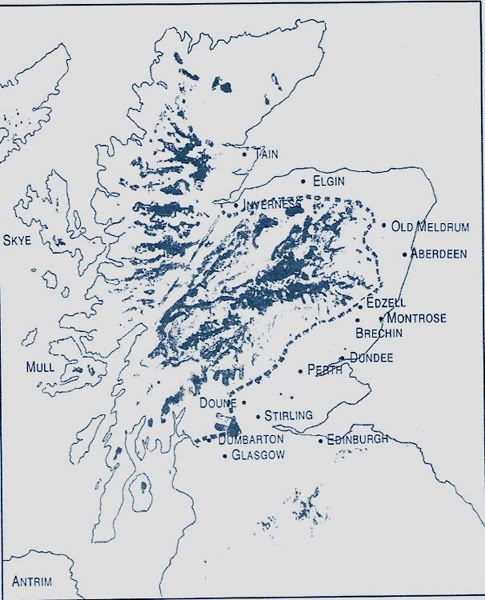
Without wishing to get too involved in this discussion I would just like to point out that Highland clans actually began just north of Glasgow (Buchanan, Colquhoun, McGregor etc) then stretched northwards and westwards. As Glasgow is considered in the "Lowlands" you can see where confusion arises. Also large parts of the "Lowlands" were Gaelic-speaking (Ayrshire, Dumfries-shire) with strong Irish connections due to their proximity to Ireland.
The eastern borders of Scotland then up to Edinburgh, Perth and beyond to Aberdeen, the non-Gaelic speaking areas, are what you might think as the "Lowlands" and the borders, in particular have much in common with the northern counties of England. They even share similarities in place names such as the Scots spelling in Bamburgh, Dunstanburgh as distinct from the southern English "borough".
-
-
23rd February 09, 08:03 PM
#35
Thanks to all, esp. MacMillan for the answers to questions I posed. I appreciate all the help. Malcolm
-
-
22nd April 09, 10:07 AM
#36
Originally Posted by puffer
One has to wonder if the "lowland" scots in Aberdeen and that area north of Perth wore what the rest of the lowlanders were wearing or if they wore what the highlanders were wearing? This is something I have often wondered about. If anyone could shead some light on this I'd appriciate it. The information out there appears to be very general when speaking of lowand dress and makes the assuption that all of the lowlands dressed the same. This, to me, sounds as ignorant as saying everyone in Scotland dressed the same. (the time period I'm particularly interested in for the area of Aberdeen is about the 1590's)
I know the Keiths (my ancestors) resettled to this are from the upper highlands several centuries prior to the 16th century.
Last edited by Matthew Siegmann; 22nd April 09 at 10:12 AM.
-
-
22nd April 09, 11:01 AM
#37
I've got both bases covered, I have both Highland/Isles AND Lowland ancestors. 
Highland dress shares quite a bit with modern Native American tribal dress. Modern Indian Pow Wow attire has taken over among the various tribes regardless of their original, tribal/regional clothing and decoration.
Scottish Highland attire has become THE national dress of Scotland, and is shared equally by both Highlander and Lowlander. Why even the Irish and Welsh have adopted it as their national dress now.
As much as we like to remain true to tradition, what is being worn today is far different that what was worn during the clan system anyway.
Last edited by Mike S; 24th April 09 at 07:38 AM.
Reason: Spelling boo boo.
My Clans: Guthrie, Sinclair, Sutherland, MacRae, McCain-Maclachlan, MacGregor-Petrie, Johnstone, Hamilton, Boyd, MacDonald-Alexander, Patterson, Thompson. Welsh:Edwards, Williams, Jones. Paternal line: Brandenburg/Prussia.
Proud member: SCV/Mech Cav, MOSB.
-
-
22nd April 09, 11:06 AM
#38
Originally Posted by Matthew Siegmann
One has to wonder if the "lowland" scots in Aberdeen and that area north of Perth wore what the rest of the lowlanders were wearing or if they wore what the highlanders were wearing? This is something I have often wondered about. If anyone could shead some light on this I'd appriciate it. The information out there appears to be very general when speaking of lowand dress and makes the assuption that all of the lowlands dressed the same. This, to me, sounds as ignorant as saying everyone in Scotland dressed the same. (the time period I'm particularly interested in for the area of Aberdeen is about the 1590's)
I know the Keiths (my ancestors) resettled to this are from the upper highlands several centuries prior to the 16th century.
IMHO, the style clothing worn would be dictated by the individual,s position in society & what was being worn locally by his peers.
I believe you are correct in your "assumption" is correct. It would be the same as "assuming" that the attire of an American living in the 1800s in TAOS, would be the same as his contemporary living in the PNW region.
Puffer
-
-
22nd April 09, 11:24 AM
#39
Originally Posted by Phil
Without wishing to get too involved in this discussion I would just like to point out that Highland clans actually began just north of Glasgow (Buchanan, Colquhoun, McGregor etc) then stretched northwards and westwards. As Glasgow is considered in the "Lowlands" you can see where confusion arises. Also large parts of the "Lowlands" were Gaelic-speaking (Ayrshire, Dumfries-shire) with strong Irish connections due to their proximity to Ireland.
The eastern borders of Scotland then up to Edinburgh, Perth and beyond to Aberdeen, the non-Gaelic speaking areas, are what you might think as the "Lowlands" and the borders, in particular have much in common with the northern counties of England. They even share similarities in place names such as the Scots spelling in Bamburgh, Dunstanburgh as distinct from the southern English "borough".
Not to cut focus from the first question here but so to understand you Clan Colquhoun Buchanan and McGregor are sort of Suburbia of the Highlands?
-
-
22nd April 09, 12:36 PM
#40
Originally Posted by NeoDreams
Not to cut focus from the first question here but so to understand you Clan Colquhoun Buchanan and McGregor are sort of Suburbia of the Highlands?
Clan Colquhoun lands(west bank and islands of Loch Lomond) are right on the border. There is a geological fault line that starts about a third up Loch Lomond that is the line. For any of you golfers watching the,I think the British open(?), on TV in early July(?) is right on the dividing line. I find the map above interesting as it is not the line we draw! We may be wrong of course! But for ease, we start the line at Loch Lomond and then draw a line through Perth and finish at Dundee.Above the line is the highlands-----it may not be correct(I am not sure),but it is easier to explain and will not be far out.
-
Similar Threads
-
By McMurdo in forum General Kilt Talk
Replies: 30
Last Post: 20th January 08, 02:43 PM
-
By Livingston in forum Miscellaneous Forum
Replies: 20
Last Post: 31st October 07, 07:26 AM
-
By herminator in forum Miscellaneous Forum
Replies: 5
Last Post: 11th September 07, 03:01 PM
-
By cavscout in forum How to Accessorize your Kilt
Replies: 12
Last Post: 3rd September 05, 07:41 AM
-
By cgordon in forum General Kilt Talk
Replies: 1
Last Post: 20th May 04, 09:32 AM
 Posting Permissions
- You may not post new threads
- You may not post replies
- You may not post attachments
- You may not edit your posts
-
Forum Rules
|
|












Bookmarks