|
-
14th August 09, 04:26 PM
#31
Without any period written descriptions of how the plaid was put on, we can only guess, make deductions from period images, and experiment.
But, in over 35 years of being involved in "living history," many are the examples I've seen of dubious "reenactorisms" assuming the role of historic facts and practices....
Brian
"They who can give up essential liberty to obtain a little temporary safety, deserve neither liberty nor safety." ~ Benjamin Franklin
-
-
14th August 09, 04:54 PM
#32
 Originally Posted by Woodsheal

Without any period written descriptions of how the plaid was put on, we can only guess, make deductions from period images, and experiment...
That's why I love experimental archaeology. Reenactors may sometimes get things wrong, but a lot of information has been gleened from going out and doing.
Jay
Clan Rose - Constant and True
"I cut a stout blackthorn to banish ghosts and goblins; In a brand new pair of brogues to ramble o'er the bogs and frighten all the dogs " - D. K. Gavan
-
-
17th August 09, 05:40 AM
#33
A very interesting discussion and you all make good points. To piggyback on hand pleating, etc......Jacobite wars will be recreated at Fort Ontario, Oswego, NY, Sept. 4 through 6. http://jacobite1745.homestead.com/IAmComeHome20081.html
Malcolm
-
-
17th August 09, 08:28 AM
#34
Originally Posted by Woodsheal
Which takes us back to my original point: we AREN'T achieving the end results shown in the period images...
Here's another example: the famous painting
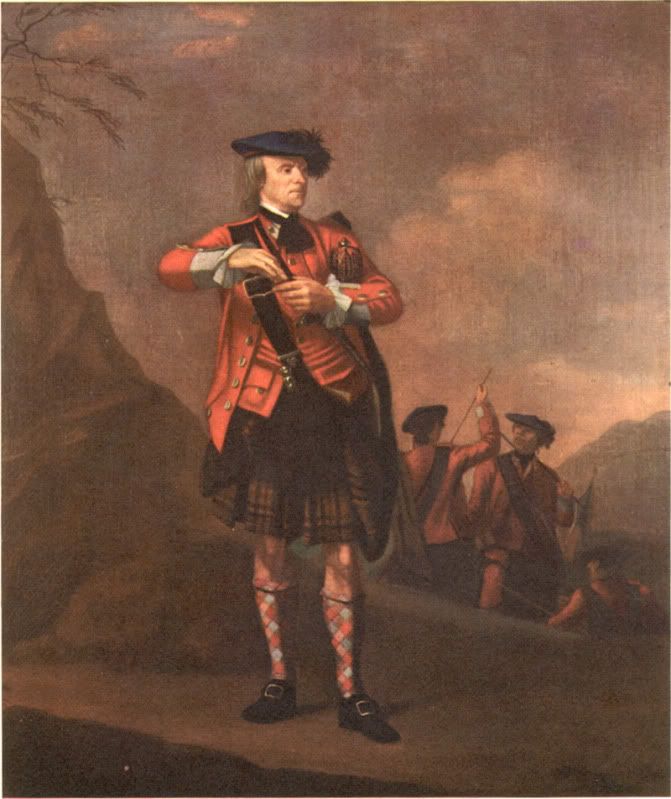
Oan a wee note, this is a painting, donned in the style of the artist's eye.
Aye  ith: ith:
-
-
17th August 09, 08:35 AM
#35
Originally Posted by shawhighlander
Oan a wee note, this is a painting, donned in the style of the artist's eye.
Aye ith:
Where have I read that before...? 
Originally Posted by JRB
That's why I love experimental archaeology. Reenactors may sometimes get things wrong, but a lot of information has been gleened from going out and doing.
I couldn't agree more! I've learned so much by doing.
"Two things are infinite- the universe, and human stupidity; and I'm not sure about the universe." Albert Einstein.
-
-
18th August 09, 03:27 PM
#36
Originally Posted by Woodsheal
Without any period written descriptions of how the plaid was put on, we can only guess, make deductions from period images, and experiment.
But, in over 35 years of being involved in "living history," many are the examples I've seen of dubious "reenactorisms" assuming the role of historic facts and practices....
Originally Posted by JRB
That's why I love experimental archaeology. Reenactors may sometimes get things wrong, but a lot of information has been gleened from going out and doing.
I would agree with both of your assessments, which is why (as "living historians") we must be careful in putting out there what little we know as "experimental archaeology" as "historical fact". Having been involved in living history for nearly 17 years, I have seen many of my contemporaries state "facts" as if they knew more than those who actually lived the times.
[SIZE="2"][FONT="Georgia"][COLOR="DarkGreen"][B][I]T. E. ("TERRY") HOLMES[/I][/B][/COLOR][/FONT][/SIZE]
[SIZE="1"][FONT="Georgia"][COLOR="DarkGreen"][B][I]proud descendant of the McReynolds/MacRanalds of Ulster & Keppoch, Somerled & Robert the Bruce.[/SIZE]
[SIZE="1"]"Ah, here comes the Bold Highlander. No @rse in his breeks but too proud to tug his forelock..." Rob Roy (1995)[/I][/B][/COLOR][/FONT][/SIZE]
-
-
18th August 09, 03:29 PM
#37
This print is part of the Boyd Album, a collection of prints and documents collected together by the Boyd Family and now in the collection of Dean castle.
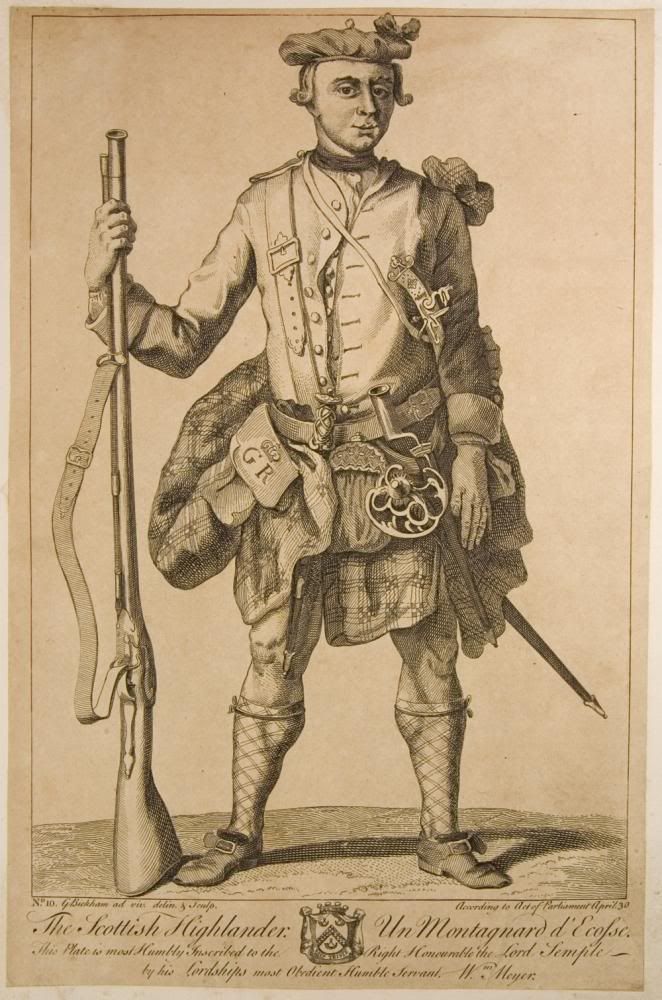
...note the disheveled appearance of his great kilt.
[SIZE="2"][FONT="Georgia"][COLOR="DarkGreen"][B][I]T. E. ("TERRY") HOLMES[/I][/B][/COLOR][/FONT][/SIZE]
[SIZE="1"][FONT="Georgia"][COLOR="DarkGreen"][B][I]proud descendant of the McReynolds/MacRanalds of Ulster & Keppoch, Somerled & Robert the Bruce.[/SIZE]
[SIZE="1"]"Ah, here comes the Bold Highlander. No @rse in his breeks but too proud to tug his forelock..." Rob Roy (1995)[/I][/B][/COLOR][/FONT][/SIZE]
-
-
19th August 09, 01:10 PM
#38
Interesting and entertaining thread - I was searching around and stumbled on these:
http://216.92.79.148/greatkilt/breacan04.htm
http://216.92.79.148/greatkilt/breacan05.htm
Of course, there's no way to guarantee authenticity, but it certainly does appear to be a valid method the putting a great kilt on without laying down. I'll have to give it a try myself once I get mine made.
-
-
20th August 09, 12:44 AM
#39
I have a friend and customer here in Victoria who lives in the Great Kilt as part of what this thread has dubbed "Experimental Archeology".
He uses a piece of cloth of the weight of an army blanket because that is about what a hand loom of the age would and did produce. (His wife wove it)
The length is about 4.25 yards and length 54" as it is two pieces sewn together. The length and width are perfect for rolling up in at night as a sleeping bag.
He wears the Leine constantly. (He washes his about every 3rd day but in the Highlands it would have been washed about once every other week or so.) His Leine is hand woven of Wool and about the thickness of a Pendleton Wool shirt.
The other clothing he uses are a pair of "Ghillie" shoes. Basically three layers of Elk hide for a sole and laced up the calf. In cold weather he adds leggings of rabbit fur, fur side in, laced with the shoelaces.
A long leather belt with no buckle. Instead it uses a horn toggle.
A large shoulder/belt pouch to carry everything he owns when in the field.
A large bladed knife in a belt/shoulder strap.
In the morning there are all sorts of things that need attending to like stoking the fire for breakfast, fetching some water, and his ablutions.
His method of getting dressed is this;
Roll out of the blanket and wrap it around his shoulders.
Go Stoke the fire.
Find the latrine and relieve himself.
Fill a water skin and splash water on his face, hands, feet, pits, and crotch. Dry off with the blanket.
Go back to the camp and put the breakfast on the fire.
Finally, standing in front of the fire to get warm he pulls the blanket over his head and shrugs it around his shoulders.
He then grabs his belt and flips it around his waist and fastens it in place catching the blanket in the process.
Voila, he is dressed.
He does it standing and it takes all of a minute to do.
To get the sort of effect and imaging what it looks like find a picture of a ladies Arasaid. Same sort of look.
It's a Leine and Brat sort of look.
After he is warm he drops the top of the blanket off his head and pins it in front with a pennanular brooch. Over both shoulders and Pinned a little to one side so it won't get caught when he slings his pouch over his shoulder before going out to tend the sheep or chop some wood.
Does it give the look of those in the portraits? No, I'm sorry it doesn't, but it works very well, is practical, and simple.
I think we tend to forget that hand woven fabric are far thicker and heavier than those we use today. To me the army blanket weight is exactly what I would want around me in the damp Scottish Highlands.
Steve Ashton
www.freedomkilts.com
Skype (webcam enabled) thewizardofbc
I wear the kilt because: Swish + Swagger = Swoon.
-
-
21st August 09, 02:43 PM
#40
Originally Posted by The Wizard of BC
I have a friend and customer here in Victoria who lives in the Great Kilt as part of what this thread has dubbed "Experimental Archeology".
He uses a piece of cloth of the weight of an army blanket because that is about what a hand loom of the age would and did produce. (His wife wove it)
Steve,
A couple of notes for your friend:
Lose the penannular brooch. They are an Iron Age/Dark Age item that fell out of use in the medieval period, long before belted plaids were worn. He should use a bodkin.
Also, surviving early plaids (I don't think any extant examples date to earlier than ca. 1700), are all described as "thin" and "hard" as opposed to thick, heavy, and blanket-like. See Dunbar's History of Highland Dress for examples of what I'm referring to. And, here's a period description of the "finer and lighter" plaids differing from the heavier tartan woven for hose and "jerkins":
http://medievalscotland.org/clothing/refs/taylor.shtml
Brian
"They who can give up essential liberty to obtain a little temporary safety, deserve neither liberty nor safety." ~ Benjamin Franklin
-
Similar Threads
-
By Kilted Craanen in forum Kilt Advice
Replies: 38
Last Post: 22nd September 09, 12:54 PM
-
By gasbag in forum How to Accessorize your Kilt
Replies: 9
Last Post: 22nd June 09, 05:06 AM
-
By mrtackytn in forum Kilt Advice
Replies: 9
Last Post: 3rd March 09, 12:02 PM
-
By Amoskeag in forum General Kilt Talk
Replies: 3
Last Post: 21st January 08, 05:39 PM
-
By Dutchomatic in forum Kilt Advice
Replies: 74
Last Post: 12th January 08, 09:36 PM
 Posting Permissions
- You may not post new threads
- You may not post replies
- You may not post attachments
- You may not edit your posts
-
Forum Rules
|
|














Bookmarks