|
-
25th August 09, 04:43 PM
#1
 Originally Posted by peacekeeper83
They are nice.... I like the kilt, myself... I just like earth tones... But that's me... I appreciate you sharing your passion with us.
That's actually the Ulster Weathered tartan, so named because the well-preserved remains of a ca. 1600 Scottish fighting man were pulled from a bog in Ulster some years back, wearing that particular sett. So, the tartan is early, but it's not really an authentic garment because it's a tailored Matt Newsome box-pleated kilt! I cheated and wore it because I'm currently waiting for the actual 18th C. style philabeg that Matt will be sewing for me in a couple of months' time....
Last edited by Woodsheal; 25th August 09 at 04:49 PM.
Brian
"They who can give up essential liberty to obtain a little temporary safety, deserve neither liberty nor safety." ~ Benjamin Franklin
-
-
25th August 09, 08:40 PM
#2
I cheat and wear my Albannach tartan kilt from USAK all the time. Nothing wrong with that- it gets hot here in the summer, and the 5 yard 13 oz wool is very comfortable in the heat. I actually like to wear the Albannach for the same reason you chose yours- it has a nice muted/weathered look to it. I can see where it would have fit right in in the late 1600's. I really do need to get a great kilt in the PV that Rocky offers.
So- things I like in those pictures- your targe. I need to finish mine. That's my winter project. Your sporran is also great! Color me jealous. Your tartan coat... I could do without one of those. Anything long sleeved in the Colorado desert in summer is bad. (That's not to say that I don't like it... I wish it were practical to wear one here.) And then there's the fact that my reenactment group is not military- we're civilian. So a more plain swordsmans vest is, I think, more approriate both for our group, and our climate.
So out of curiosity, where did you get the musket? I have two from my great great grandfather that I have on occasion considered taking with me to reenactments, but they're family heirlooms and I can't quite convince myself to risk one of them. Also, where did you get the satchel? That's one thing I've been looking for and have been unable to find- at least one that suits my tastes I suppose.
If you're interested, my groups website is www.renscots.org
"Two things are infinite- the universe, and human stupidity; and I'm not sure about the universe." Albert Einstein.
-
-
26th August 09, 03:53 PM
#3
My firelock (in these two most recent pics) is a custom-made piece; a reproduction of an English-type fowling piece - basically a hunting arm as opposed to a military musket. Scottish gunsmiths built such pieces, as well: a gun a well-off "clan gentleman" might carry.
Your "rank-and-file" clansman of the '45 would most likely carry an issued French infantry musket. Some 1,600 of these were shipped into Scotland from France during the Rising and issued to Jacobite troops, mostly highlanders. (Captured British arms - "Brown Bess" muskets - were generally earmarked for arming lowland units and the Manchester Regiment.) We're not absolutely sure which model these French muskets were, but the consensus is they were most likely the M1717 Fusil D'Infanterie. You can get attractively priced repros of these muskets here:
http://www.middlesexvillagetrading.com/NEW1717.shtml
If your group would find earlier 17th C. firearms more appropriate to your portrayal, the same source has some nice examples:
http://www.middlesexvillagetrading.c...hcentury.SHTML
The leather satchel is a simple, early-style shooting pouch, much like this one. Plain ol' linen haversacks were also common for many decades, if not centuries.
Brian
"They who can give up essential liberty to obtain a little temporary safety, deserve neither liberty nor safety." ~ Benjamin Franklin
-
-
26th August 09, 06:48 PM
#4
Very nice overall! My questions about the musket have already been answered (that is unless you know of anyone that might make a functional version of the French 1717 model) but where did you get the tartan coat?
-
-
17th November 09, 06:59 PM
#5
 Originally Posted by Woodsheal
That's actually the Ulster Weathered tartan, so named because the well-preserved remains of a ca. 1600 Scottish fighting man were pulled from a bog in Ulster some years back, wearing that particular sett. So, the tartan is early, but it's not really an authentic garment because it's a tailored Matt Newsome box-pleated kilt! I cheated and wore it because I'm currently waiting for the actual 18th C. style philabeg that Matt will be sewing for me in a couple of months' time....
Now my question for you here, is what is the particular style / distinguishing features of the kilt that you're having made? I'm attempting to portray a persona at the end of the Jacobite rebellion and much prefer the philabeg to the plaid when wearing waistcoat, jacket, bonnet, etc. Right now i've been wearing a slightly tailored philabeg, 3.75 yards of single width fabric with 8 large (around 3 inch wide) pleats sewn at just the very top in the back, held in place just by a belt. I know that, unfortunately, we have no surviving examples of a philabeg from the time, but I'm always on the look out for how others are interpreting it.
Thanks,
-Justin
-
-
22nd November 09, 11:47 AM
#6
Think of the philabeg worn by Rob in the film Rob Roy: unpressed box pleats, narrow front aprons, no fringe, etc. Highland dress historian Peter MacDonald was the costume consultant for that movie, and that's what he believes early "little kilts" were like.
The notion that the first philabegs were hand-pleated each time by the wearer is a "reenactorism" unsubstantiated by any period documentation or image. Did they have a drawstring or belt-loops? Were the pleats stitched into place from the get-go? We simply don't know, as none survive from the period of earliest use. The earliest surviving philabegs date to the 1790's and feature sewn-in box pleats. Does this represent earlier practice? Probably, but again,we don't know for sure....
Brian
"They who can give up essential liberty to obtain a little temporary safety, deserve neither liberty nor safety." ~ Benjamin Franklin
-
-
23rd November 09, 04:45 AM
#7
 Originally Posted by Woodsheal
Think of the philabeg worn by Rob in the film Rob Roy: unpressed box pleats, narrow front aprons, no fringe, etc. Highland dress historian Peter MacDonald was the costume consultant for that movie, and that's what he believes early "little kilts" were like.
The notion that the first philabegs were hand-pleated each time by the wearer is a "reenactorism" unsubstantiated by any period documentation or image. Did they have a drawstring or belt-loops? Were the pleats stitched into place from the get-go? We simply don't know, as none survive from the period of earliest use. The earliest surviving philabegs date to the 1790's and feature sewn-in box pleats. Does this represent earlier practice? Probably, but again,we don't know for sure....
As the feilidh-mor (the garment from which the feilidh-beag evolved) was an untailored garment, it is generally thought that the earliest versions of the feilidh-beag would have been untailored, as well.
However, there is a logical reason for leaving the feilidh-mor untailored. It was basically a blanket, and was used as such when not being worn. Having the pleats sewn in would take away from its functionality.
The same could not really be said of the abbreviated feilidh-beag, though. Being narrow in width, its use as a blanket would be limited, at best. It's primary purpose was for clothing.
So I can well imagine that it would not have taken long after its first introduction before people started to wonder, "Why am I pleating this thing up every time I put it on? Wouldn't it be easier to sew these into place?"
The first tailored kilts were very likely sewn up at the waist only. Later on they were sewn from waist to hip, as we know them. This is speculation, though. The truth is we do not really know. As Brian said, we only have surviving examples from the 1790s. The earliest kilt for which a date can be documented with any certainty is a Gordon Highlanders regimental kilt from 1796. It has less then four yards, and is box pleated with the pleats sewn from waist tio hip -- no tapering, no lining, no fastening, self-fringe on the aprons.
The fact that we have no surviving examples from before then does not prove whether the early feilidh-beag was tailored or not. But it does suggest not. One of the reason we don't see surviving feilidh-mor is that it was an untailored garment -- a large blanket. When the cloth began to wear thin and no longer be usable as a garment, it was likely repurposed. Any usable parts of the cloth may have been used for other garments, anything unusable may have been used for rags or thrown away. The same could be said for the fate of any untailored feilidh-beag.
-
-
27th August 09, 05:31 AM
#8
 Originally Posted by Woodsheal
Thanks to the mods for initiating this forum! I'll start the ball rolling....
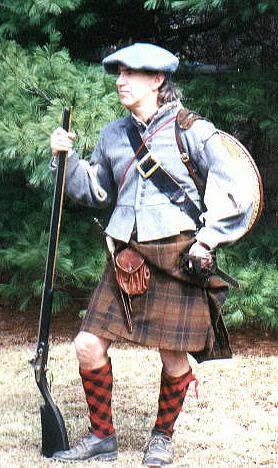
We occasionally hear mention of "Jacobite" items of clothing, be it "Jacobite Jackets" or "Jacobite Shirts." The problem here is that the period of the Jacobite Risings in Scotland encompassed the period from 1689 to 1746, and fashions changed and evolved quite a bit during that stretch of years (even in the "backwards" Highlands!).
Here's a look from the beginning of the period, with belted plaid, hodden grey doublet, and woad-dyed blue bonnet:
And here's one fromthe tail-end of the period, the `45 Rising, with philabeg, tartan coat, and indigo-dyed bonnet (indigo imports got cheaper in the intervening years) with the white cockade (not worn in earlier risings):
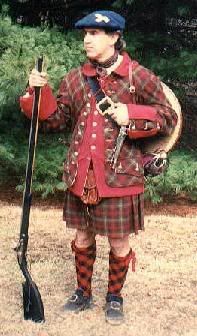
Quite a different look between the two extremes of the Jacobite era...!
Nice one, where did you get the jacket in the firsr picture?
-
-
27th August 09, 03:30 PM
#9
 Originally Posted by am1745
Nice one, where did you get the jacket in the firsr picture?
A reenactor friend's wife made it for me. The pattern is simply a typical mid-1600's doublet with slashed sleeves, pretty much worn throughout Europe at the time....
Brian
"They who can give up essential liberty to obtain a little temporary safety, deserve neither liberty nor safety." ~ Benjamin Franklin
-
-
24th September 09, 05:34 PM
#10
thay twa must hae been lairds thay wir weel dressed maist ordinari clansmen didnae hae say fanci claithes nor shin on thair feet nor hae a musket ,maist highlanders wir jist workin men fer a laird ain wid hae thair faimli sword fundit bi thair faithir ait anithir battle in amangst thi thatch bit moni just yaised thair workin shuchs maybi a axe aur a scyth wi a woodin handel, Thi Highland regali seen here ain maist picturs is part militari kit
-
Similar Threads
-
By Woodsheal in forum Highland Games and Celtic Event Discussion
Replies: 11
Last Post: 14th May 09, 07:55 AM
-
By Hamish in forum Contemporary Kilt Wear
Replies: 27
Last Post: 24th February 09, 07:27 PM
-
By Woodsheal in forum Highland Games and Celtic Event Discussion
Replies: 3
Last Post: 22nd August 08, 07:04 PM
-
By S.G. in forum General Kilt Talk
Replies: 17
Last Post: 30th July 08, 03:21 PM
-
By Robinhood in forum General Kilt Talk
Replies: 63
Last Post: 3rd March 07, 10:04 PM
Tags for this Thread
Posting Permissions
- You may not post new threads
- You may not post replies
- You may not post attachments
- You may not edit your posts
-
Forum Rules
|
|
Bookmarks